Card Printer Volume Guide: Cards Per Month Explained
Table of Contents []
- Choosing the Right Card Printer: A Volume Guide for Every Organization - Plastic Card ID
- Why Print Volume Is the Foundation of Every Card Printer Decision
- Entry-Level Card Printers: The Right Choice for Low-Volume Programs
- Mid-Range Card Printers: The Workhorses of Serious ID Programs
- High-Volume and Premium Card Printing: When Quality and Speed Both Matter
- What In-House Card Printing Actually Gives Your Organization
- Buyer's Guide: Questions to Answer Before You Purchase
- Start Printing with Confidence - Plastic Card ID Has Your Program Covered
Choosing the Right Card Printer: A Volume Guide for Every Organization - Plastic Card ID
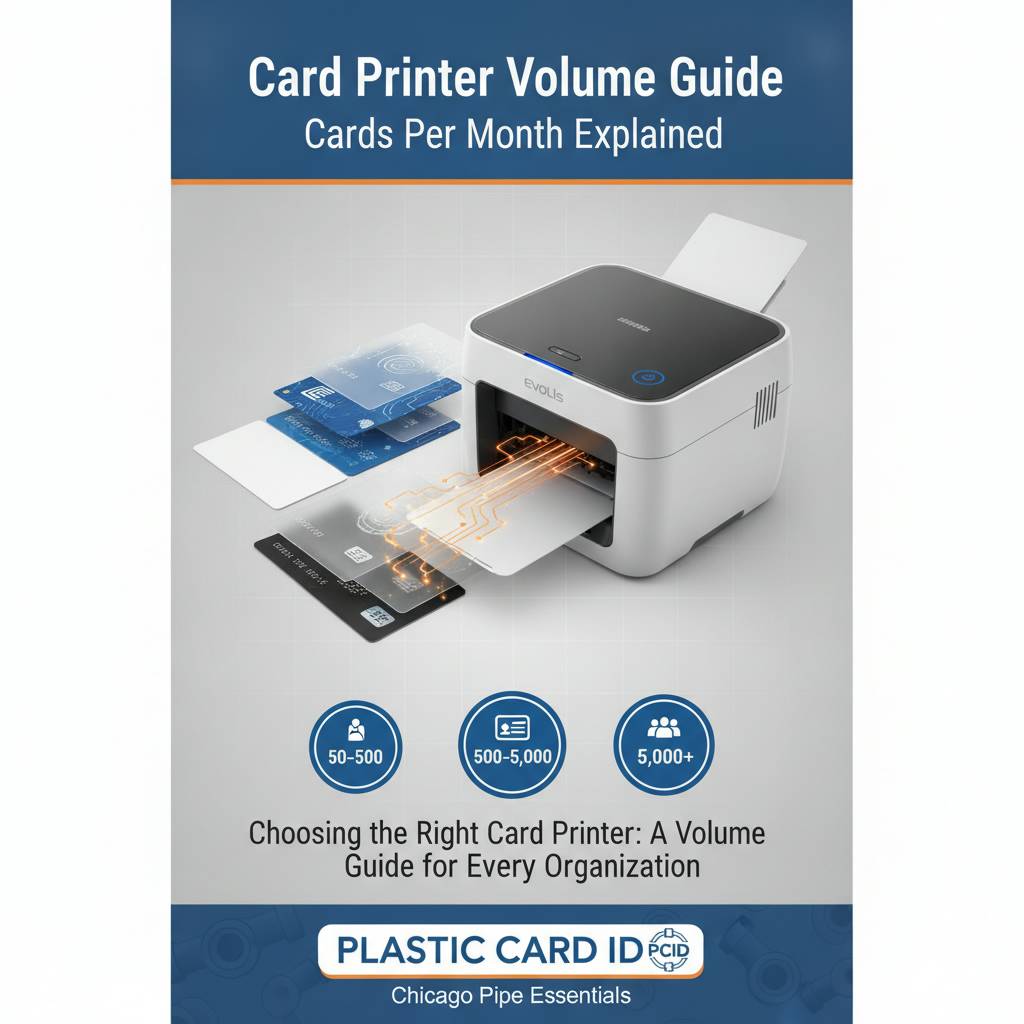 What actually separates a smart card printer purchase from a regrettable one? Volume. Print volume - cards per month, cards per year, cards per event - is the single most decisive factor in matching a printer to a real-world workflow. Get it right, and your program runs smoothly for years. Get it wrong, and you're either bottlenecked by an underpowered machine or paying for industrial capacity you'll never use.
Plastic Card ID has spent over 25 years guiding businesses, schools, healthcare facilities, and event organizers through exactly this decision. With more than 100,000 customers served across the United States, CPE has seen every scenario - and the right printer match makes all the difference.
| Volume Tier | Cards Per Month | Recommended Printer | Best Use Case |
|---|---|---|---|
| Entry-Level | Fewer than 85/month | Evolis Badgy200 | Small offices, clubs, schools |
| Mid-Range | 1,000 to 6,000/month | Evolis Zenius / Primacy2 | Corporate ID, loyalty programs |
| High-Volume | 6,000/month | Evolis Agilia / Matica | Enterprise, events, large campuses |
| Security-Grade | Any volume | Fargo / Zebra | Government, access control, compliance |
Why Print Volume Is the Foundation of Every Card Printer Decision
 Before brand names, before feature lists, before price tags - volume is the conversation that matters. A printer rated for 500 cards per month pushed to produce 3,000 will degrade prematurely, jam frequently, and cost far more in repairs and replacements than a properly sized unit ever would. Understanding your actual output needs isn't just helpful - it's the entire ballgame.
The math isn't complicated, but people consistently underestimate their needs. Think about not just current card counts, but projected growth, seasonal spikes, and the cumulative card types you handle. An HR department that currently prints 200 employee badges per month might add access control cards, visitor passes, and contractor credentials - suddenly you're looking at 600 or 800 per month and a different printer tier entirely.
How to Accurately Estimate Your Monthly Card Volume
Start with your most recent 12 months of card issuance if you have records. If you're starting fresh, estimate by headcount, membership size, or event attendance. Divide annual projections by twelve to get a monthly average - but also note your peak months, because your printer needs to handle the busiest period without failing.
Add a 20-30% buffer above your average. This accounts for reprints, damaged cards, test prints during setup, and the natural growth almost every organization experiences. Buying right-sized hardware from the start saves significant money over the lifetime of a card program.
Single-Sided vs. Dual-Sided Printing and Its Effect on Volume Calculations
Dual-sided printing effectively doubles the print passes per card, which impacts both throughput speed and ribbon consumption. If your ID cards require information on both sides - photo and name on front, barcode and department on back, for example - factor this into your volume calculations. A printer rated at 150 cards per hour single-sided may output 90 or fewer dual-sided.
Mid-range printers like the Evolis Primacy2 handle dual-sided output efficiently without sacrificing speed for moderate volumes. For organizations routinely printing dual-sided cards in the thousands per month, stepping up to a higher-capacity model pays for itself quickly in time saved and consistent output quality.
Seasonal Spikes and Event-Driven Volume Surges
Universities issuing student IDs at fall enrollment, corporate campuses onboarding seasonal contractors, conference organizers printing event credentials on-site - these scenarios all involve dramatic short-term volume spikes. A printer that can't handle the surge creates real operational problems precisely when reliability matters most.
Planning for peak capacity rather than average capacity is a discipline the most prepared organizations practice. CPE carries solutions at every scale, including the Matica Event Printer specifically designed for high-speed on-site badge production, so surges become manageable rather than chaotic.
Entry-Level Card Printers: The Right Choice for Low-Volume Programs
Not every organization needs industrial output. A small nonprofit, a local fitness club, a boutique hotel, a regional association - these operations may print fewer than 1,000 cards per year. Spending thousands on a high-capacity printer that sits idle most of the time is simply poor resource allocation. Entry-level printers deliver full professional quality at a scale and price that matches modest production needs.
The Evolis Badgy200 is the defining example of a well-engineered entry-level card printer. Compact, reliable, and straightforward to operate, it produces sharp, professional-grade PVC cards without demanding technical expertise or a dedicated print station. For organizations new to in-house card printing, it's an accessible starting point that doesn't compromise on output appearance.
Evolis Badgy200: Built for the Occasional but Serious Printer
The Badgy200 handles YMCKO color ribbon printing for full-color photo ID cards and supports standard CR80 card stock. Its compact footprint means it fits on a desk without consuming workspace, and setup is designed to be completed by non-technical staff. For clubs, small schools, or businesses issuing a few dozen cards monthly, it's a confident choice.
Consumable costs at low volume are particularly manageable. A single YMCKO ribbon for the Badgy200 covers a defined card count, and because the printer isn't running constantly, wear is minimal. The total cost of ownership over several years for a low-volume program using the Badgy200 is genuinely favorable compared to outsourcing card production.
When to Reconsider the Entry-Level Tier
The clearest signal that an entry-level printer is undersized is when you're printing more than two to three times per week and finding the process creates backlog. Another warning sign is needing features the entry-level model doesn't offer - magnetic stripe encoding, smart chip programming, dual-sided output, or lamination. These capabilities require stepping up the product tier.
Contact Plastic Card ID at 800.835.7919 if you're uncertain whether an entry-level printer meets your needs. The team will ask the right questions and make sure you're matched to the right solution - not oversold and not undersupported.
Supplies That Keep Entry-Level Programs Running
Even the simplest card printer program needs a consistent supply of the right consumables. For entry-level printers, this typically means YMCKO color ribbons, cleaning kits to maintain print head health, and quality PVC card stock. Sourcing these from a single, reliable supplier simplifies reordering and ensures compatibility.
CPE stocks ribbons, cleaning kits, and card accessories for every printer in its lineup - including entry-level models. Having your consumables and hardware from the same source eliminates compatibility guesswork entirely.
Mid-Range Card Printers: The Workhorses of Serious ID Programs
 Organizations printing between 1,000 and 6,000 cards per month need something more capable than a desktop entry unit, but they don't necessarily require industrial-scale hardware. This mid-range tier is where the majority of corporate HR departments, universities, healthcare facilities, government agencies, and membership organizations operate. It's also where the feature set expands significantly - and where the right choice gets nuanced.
The Evolis Zenius and Evolis Primacy2 anchor this tier. Both deliver consistent, high-quality output at sustained monthly volumes, with support for encoding options, dual-sided printing, and optional lamination modules. These are printers built to run daily without complaint - exactly what an active card program demands.
Evolis Zenius: Efficient, Clean, and Capable
The Zenius is a single-sided card printer that shines in environments where clarity, efficiency, and ease of use matter. It uses a retransfer-adjacent printing process that produces sharp, well-saturated color ID cards consistently. For organizations where cards are primarily single-sided - employee badges, membership cards, student IDs - the Zenius hits a strong value-to-performance balance.
Adding magnetic stripe encoding to the Zenius extends its utility for access control applications, loyalty card programs, and any use case requiring machine-readable data on the card's magnetic track. This optional upgrade transforms a straightforward printer into a capable encoding workstation for mid-volume programs.
Evolis Primacy2: The Go-To for Dual-Sided Mid-Volume Production
Where the Primacy2 distinguishes itself is dual-sided printing throughput. Organizations issuing cards with photo ID on one side and barcode, department, and emergency contact on the other - the Primacy2 handles this without slowing production to a crawl. It's a robust machine that tolerates daily use across extended periods with proper maintenance.
The Primacy2 also supports encoding upgrades and an optional lamination module, making it a genuine all-in-one solution for sophisticated card programs. When your card requirements include multiple data layers, dual-sided print, and security overlaminates, the Primacy2 is where serious programs live.
Consumables and Encoding Options for Mid-Range Printers
- YMCKO Ribbons: Full-color ribbons for photo ID quality output with a clear overcoat layer for card protection
- Monochrome Ribbons: Single-color ribbons ideal for high-speed text and barcode-only cards at reduced per-card cost
- Specialty Ribbons: Security and holographic overcoat options for enhanced card durability and counterfeit resistance
- Magnetic Stripe Encoding Modules: Integrated or add-on encoding for HiCo and LoCo magnetic stripes on loyalty, access, and ID cards
- Smart Chip Encoding: Contact and contactless chip programming for advanced access control and secure credentialing
- Cleaning Kits: Roller and print head cleaning supplies to maintain print quality and extend printer lifespan
- Lamination Modules: Protective overlaminates for higher-security, longer-wearing cards
Keeping all consumables sourced through CPE ensures that what goes into your printer is designed to work with it. Mismatched ribbons and off-brand cleaning supplies are a leading cause of preventable print head failures in active card programs.
High-Volume and Premium Card Printing: When Quality and Speed Both Matter
 Above 6,000 cards per month, the conversation shifts fundamentally. Throughput, duty cycle, and output precision all take on greater weight. An organization running a campus-wide access control program, a national retail loyalty rollout, or a large healthcare network's employee credentialing system cannot afford print interruptions. High-volume card printing demands hardware engineered for sustained industrial performance.
This is where the Evolis Agilia and the Matica Event Printer enter the picture. These are not simply larger versions of mid-range printers - they represent a different engineering philosophy, prioritizing reliability under load, output consistency across very high card counts, and the ability to integrate into automated or semi-automated card issuance workflows.
Evolis Agilia: Premium Output at Industrial Scale
The Agilia delivers edge-to-edge printing with the highest quality color output in the Evolis lineup. For organizations where the card itself is a brand statement - premium membership programs, financial institution credentials, high-end hospitality - the Agilia's output quality is perceptibly superior. Every card looks precisely intentional.
Beyond aesthetics, the Agilia supports the full range of encoding options and lamination configurations. It's designed to integrate with enterprise card management systems and to operate continuously in high-demand environments. If your cards represent your brand's first physical touchpoint with customers, the Agilia is the printer that delivers that impression without compromise.
Matica Event Printer: Purpose-Built for On-Site Badge Production
The Matica Event Printer occupies a specialized but critically important niche: high-speed on-site badging at events, conferences, expos, and large venue check-ins. When thousands of attendees need credentials printed and issued within hours - or minutes - at registration, standard office printers simply fail to keep pace. The Matica is built for exactly this scenario.
Speed and reliability under sustained burst-volume conditions define the Matica's engineering priorities. Organizations running recurring events or managing large-scale on-site credentialing operations find the Matica's throughput capacity transforms what's operationally possible at check-in.
Fargo and Zebra Printers: Security-First at Any Volume
Fargo and Zebra have built their card printer reputations on security-grade output - government IDs, law enforcement credentials, corporate access control cards, and compliance-driven identity programs. Both brands offer solutions across the volume spectrum, from departmental units to enterprise systems, all with robust support for security features like holographic overlaminates, UV printing, and multi-layer encoding.
For organizations where card security and tamper resistance are non-negotiable program requirements - not optional add-ons - Fargo and Zebra printers deliver the engineering to match. Plastic Card ID carries a curated selection from both brands to serve customers where identity security is mission-critical.
What In-House Card Printing Actually Gives Your Organization
There's a tendency to view in-house card printing as primarily a cost decision - and it often is cost-effective. But the more transformative benefit is control. Printing on demand means a new employee has their ID badge on their first day, not two weeks later. A lost card gets replaced the same afternoon. A loyalty card program can launch without minimum order quantities dictating your timeline.
Total operational control over your card program is genuinely powerful - and it compounds over time. The longer an organization runs an in-house program, the more refined the workflow becomes, the lower the per-card cost drops, and the more responsive the program is to changing business needs. Organizations that have made the switch rarely consider going back to external vendors.
Use Cases Where In-House Printing Delivers the Clearest Value
- Employee ID Badges: Print on hire, replace on loss, update on promotion - no vendor lead times
- Membership Cards: Issue immediately at point of signup; encode loyalty or access data in real time
- Student ID Cards: Manage enrollment-cycle volume spikes with a printer sized for the task
- Hotel Key Cards: Encode and issue at check-in; reprint instantly when cards demagnetize
- Event Credentials: Print badges on-site at registration; update attendee data night-before and print morning-of
- Access Control Cards: Program and issue proximity or smart chip cards in-house with full data control
- Visitor Passes: Print temporary, dated visitor credentials on demand at reception
The common thread across all of these is immediacy and personalization. Every card produced on an in-house printer can carry individual data - name, photo, encoded credentials, department, expiration date - without batch minimums or per-card vendor fees for customization.
The Role of Ribbons, Cleaning, and Consumables in Program Success
A printer is only as good as the consumables running through it. Using the correct ribbon type for your card type and volume tier dramatically affects both output quality and printer longevity. YMCKO ribbons for full-color photo IDs, monochrome ribbons for barcode-only cards at high volume, specialty ribbons for security applications - the right match matters every print run.
Cleaning kits are not optional maintenance. Print head contamination from card dust and ribbon residue is responsible for the majority of print quality degradation in card printers. A consistent cleaning schedule - coordinated with ribbon changes - protects your hardware investment and maintains the sharp, professional output your card program depends on.
Input Hoppers, Card Carriers, and Program Infrastructure
High-volume programs especially benefit from input hoppers that allow continuous card loading without manual intervention between batches. This seemingly simple hardware addition can meaningfully increase effective throughput for programs running hundreds of cards in a sitting. Card carriers and sleeves complete the output side, protecting printed cards during distribution and extending card life in daily use.
CPE supplies the complete infrastructure around the printer - not just the hardware itself. A well-supplied card program runs smoothly because every component from input to output is properly supported.
Buyer's Guide: Questions to Answer Before You Purchase
 Even with a clear volume picture, buying a card printer involves several secondary decisions that can meaningfully affect satisfaction with the final choice. The questions below are the ones Plastic Card ID most commonly helps customers work through before placing an order.
The goal isn't to make the decision more complicated - it's to surface the factors that matter so the right printer goes home with the right customer. A little clarity upfront prevents a lot of friction later.
Key Questions Every Buyer Should Answer
- How many cards do I print per month on average, and what is my peak monthly volume?
- Do my cards require single-sided or dual-sided printing?
- Do I need magnetic stripe encoding, smart chip programming, or both?
- Is lamination or a security overcoat required for my card type?
- What software am I using or planning to use for card design and data management?
- How many people will operate the printer, and what is their technical comfort level?
- Do I have occasional large event batches that differ significantly from my monthly average?
These answers, taken together, define a printer profile. CPE uses exactly this kind of structured thinking to match customers to the right hardware - not the most expensive option, and not the cheapest, but the one that fits the actual program requirements.
Total Cost of Ownership vs. Sticker Price
The purchase price of a card printer is one part of a multi-year cost picture. Ribbon cost per card, cleaning supply frequency, maintenance schedules, and the cost of premature printer failure from an undersized unit all factor into what in-house card printing actually costs your organization. A printer that seems expensive at purchase can be the most economical choice over a three-to-five-year operating horizon.
Conversely, the cheapest printer in a category often carries the highest per-card consumable cost - a trade-off that disadvantages higher-volume programs significantly. Understanding the full cost model before purchase is how experienced buyers make decisions that hold up well over time.
Getting Expert Guidance Before You Buy
With over 25 years and 100,000 customers of experience, CPE has encountered virtually every card program configuration imaginable. The team's ability to ask the right questions and translate volume and feature needs into specific hardware recommendations is a genuine resource for buyers who want confidence in their purchase, not just a transaction.
Call 800.835.7919 to speak directly with the Plastic Card ID team about your card program requirements. Whether you're starting from scratch or upgrading an existing setup, expert guidance takes the guesswork out of one of the more consequential purchases in any organization's operational toolkit.
Start Printing with Confidence - Plastic Card ID Has Your Program Covered
 Volume, features, encoding, consumables, security - it's a lot to consider. But with the right partner and the right information, the path from requirement to running card program is straightforward. Plastic Card ID exists precisely to make that path clear for businesses, schools, healthcare organizations, event operators, and every other enterprise that needs professional-grade plastic cards produced reliably and in-house.
The lineup covers every production scale. The consumables supply keeps programs running without interruption. The expertise behind the product selection ensures customers walk away with hardware that fits their actual workflow, not just a generic recommendation. After 25 years and over 100,000 customers served, CPE has built a track record that speaks for itself.
Ready to find the right card printer for your volume and program needs? Call Plastic Card ID today at 800.835.7919 and get matched to the printer that makes your card program run exactly the way it should.
Previous Page