Plastic Card Printer for Hotel Key Cards Explained
Table of Contents []
- Why Hotels Are Bringing Card Printing In-House with Plastic Card ID
- The Best Plastic Card Printers for Hotel Key Cards
- Encoding Options: Getting the Right Data on Every Card
- Essential Supplies to Keep Your Card Program Running
- Buyer's Guide: Choosing the Right Hotel Key Card Printer
- Frequently Asked Questions About Hotel Key Card Printing
- Partner with Plastic Card ID for Your Hotel Key Card Printing Program
Why Hotels Are Bringing Card Printing In-House with Plastic Card ID
 Picture this: a guest arrives at your front desk at 11 PM, luggage in hand, exhausted from a delayed flight. They need their room key immediately. If your hotel relies on an outside vendor for pre-encoded cards, you're either overstocked with blanks that may not match your current room assignments, or scrambling to make something work. In-house card printing eliminates that problem entirely - and it's exactly what Plastic Card ID has been helping hospitality businesses achieve for over 25 years.
The demand for reliable, on-demand plastic card printing in the hotel industry has grown considerably as properties look to reduce operational friction, cut down on vendor dependency, and deliver a more polished guest experience. Encoding hotel key cards directly at the property means total control over personalization, room assignment data, and card lifecycle management. CPE has spent decades supplying the printers, ribbons, encoding hardware, and accessories that make all of this possible - and they know hospitality operations inside and out.
Serving more than 100,000 customers across the United States, Plastic Card ID carries a carefully curated lineup of professional-grade card printers from Evolis, Fargo, Zebra, and Matica - each brand selected for its reliability, output quality, and suitability for real business environments. Whether your hotel prints 200 key cards a month or 2,000, there is a solution in this lineup built precisely for your volume and workflow.
What Makes Hotel Key Card Printing Different
Hotel key cards aren't simple ID badges. They carry encoded data - typically magnetic stripe or smart chip information - that communicates directly with door lock systems, elevator access controls, and sometimes even spa or parking gate systems. Getting the encoding right is non-negotiable, which means the printer you choose must match the encoding technology your lock system requires.
Magnetic stripe encoding is the most common standard in hospitality, with most legacy hotel lock systems reading Track 1, Track 2, or Track 3 data. Smart chip encoding is increasingly common in newer installations. Plastic Card ID supplies printers with both magnetic stripe and smart card encoding modules, ensuring compatibility with the widest range of lock system manufacturers on the market today.
Print On Demand vs. Pre-Printed Stock
Many smaller properties still operate on pre-printed card stock purchased in bulk from outside vendors. It works - until it doesn't. Pre-printed inventory runs out unexpectedly, cards get damaged, and re-ordering introduces delays that your front desk simply can't afford during peak season. On-demand printing solves all of that by letting your staff produce exactly the cards they need, exactly when they need them.
In-house printing also opens the door to greater personalization. Hotels can print the guest's name on the card, include loyalty program information, add the property's branding with full-color graphics, or differentiate card types visually by floor, room tier, or access level. These aren't luxury features - they're practical tools that improve both operations and guest perception simultaneously.
How Plastic Card ID Supports Hospitality Customers
The relationship doesn't end at the sale. Plastic Card ID supplies ongoing consumables - printer ribbons, cleaning kits, blank card stock, and replacement parts - to keep hotel card programs running without interruption. Ribbons are available in YMCKO full-color formulations for vibrant printed key cards, as well as monochrome options for cost-effective high-volume printing when color isn't required.
When questions arise about compatibility, setup, or expanding an existing card program, CPE is the resource hospitality teams rely on. Call 800.835.7919 to speak with someone who understands the nuances of hotel key card printing and can help match your property to the right hardware configuration from the start.
The Best Plastic Card Printers for Hotel Key Cards
 Selecting the right printer comes down to three variables: monthly card volume, required encoding capabilities, and the visual quality your brand demands. Plastic Card ID stocks printers across every tier of that spectrum, so there's no reason to overspend on industrial capacity you don't need - or to underbuy and create bottlenecks during your busiest check-in periods.
Below is a comparative overview of the primary printer categories available through Plastic Card ID, mapped to common hospitality use cases. Following the table, each product segment is explored in detail to help you identify the best fit for your property's specific needs.
| Printer Model | Monthly Volume | Encoding Options | Best For |
|---|---|---|---|
| Evolis Badgy200 | Up to 83/month | Basic | Small boutique hotels |
| Evolis Zenius | 1,000-3,000/month | Mag stripe, smart chip | Mid-size properties |
| Evolis Primacy2 | Up to 6,000/month | Mag stripe, smart chip, dual-sided | Full-service hotels |
| Evolis Agilia | High volume | Full encoding suite | Premium brands, resorts |
| Matica Event Printer | High-speed burst | Flexible | Conference hotels, events |
| Fargo / Zebra | Varies | Security-grade encoding | Enterprise, resort complexes |
Evolis Printers: The Hospitality Workhorse
Evolis has built a reputation for producing reliable, high-quality desktop card printers that punch well above their price class. For hotel key card applications, the Evolis Zenius and Primacy2 represent the sweet spot for most mid-size and full-service properties. The Zenius handles single-sided printing with magnetic stripe encoding as a standard upgrade option, while the Primacy2 steps up to dual-sided output - useful when hotels want to print branding or room information on the reverse side of the key card.
The Evolis Primacy2 is particularly well-regarded in the hospitality sector because of its card throughput capacity and its support for both magnetic stripe and smart chip encoding within the same unit. A full-service hotel printing check-in cards, loyalty tier cards, and staff access credentials can manage all three use cases from a single device, reducing the complexity and footprint of the front desk setup.
Evolis Agilia: When Quality Cannot Be Compromised
For luxury properties and resort brands where the key card itself is a brand touchpoint, the Evolis Agilia delivers edge-to-edge, full-bleed printing with the kind of color accuracy and resolution that makes guests take notice. A beautifully printed hotel key card isn't a gimmick - it reinforces brand identity at the exact moment a guest first engages with the physical property experience.
The Agilia supports the full range of encoding upgrades and is designed for higher production volumes without sacrificing print quality. Resorts that produce hundreds of cards per day - across multiple room tiers, amenity access levels, and seasonal variations - will find the Agilia's throughput and consistency essential to maintaining operational flow without reprints or card failures.
Fargo and Zebra: Security-Grade Hotel Access Cards
Certain hotel environments - particularly large corporate-focused properties, extended-stay complexes, or hotels that share access infrastructure with office or retail tenants - require a higher level of card security. Fargo and Zebra printers are built with security-focused card programs in mind, supporting advanced encoding formats and producing cards that integrate seamlessly with more complex access control ecosystems.
Contact 800.835.7919 to discuss which Fargo or Zebra configuration is compatible with your specific lock system or access control platform. CPE can walk through the technical specifications and help you avoid costly mismatches between printer hardware and your existing infrastructure.
Encoding Options: Getting the Right Data on Every Card
There's a gap between printing a card and printing a functional hotel key card. The visual output is only half the equation. Encoding is the invisible layer that makes the card actually work - opening the right doors, activating the right systems, and identifying the right guest. Understanding your encoding requirements before selecting a printer is critical, and it's where Plastic Card ID adds tremendous value as a knowledgeable supplier rather than just a hardware reseller.
Magnetic Stripe Encoding for Hotel Lock Systems
Magnetic stripe technology remains the backbone of hotel key card systems worldwide. Most legacy and mid-generation lock systems from major manufacturers read one or more of the three standard data tracks on the card's magnetic stripe. Hotels need to know which tracks their system uses and whether the write density (HiCo vs. LoCo) is specified by their lock system vendor.
Printers from Plastic Card ID's lineup include magnetic stripe encoding modules that write data at both high coercivity (HiCo) and low coercivity (LoCo) settings. Choosing the wrong coercivity can result in cards that deactivate prematurely or fail to read reliably - a front desk nightmare that's entirely avoidable with the right printer configuration from the start.
Smart Card and Contactless Chip Encoding
Newer hotel lock systems increasingly use contactless smart card technology - RFID-based cards that don't require physical contact with the reader. These cards can carry significantly more data than magnetic stripe cards and offer greater flexibility for multi-function key cards that also serve as loyalty identifiers or amenity access credentials.
Contact smart card encoding is also supported across several models in Plastic Card ID's lineup, applicable in environments where the lock system or access control infrastructure uses contact chip cards. The encoding module options vary by printer model, so it's worth having a clear picture of your lock system's card specification before finalizing your hardware order.
Dual-Sided Printing for Maximum Card Functionality
When hotels want to maximize the real estate on each card - printing a branded design on the front and encoding or informational content on the back - dual-sided printing capability becomes essential. The Evolis Primacy2 handles this without requiring manual card flipping, streamlining the card production process significantly for front desk staff who need to produce multiple cards quickly during group check-ins or high-traffic periods.
Dual-sided printing also enables hotels to include instructional content on the card back, such as checkout times, contact numbers, or QR codes for digital services - turning the key card into a useful communication tool rather than just an access device.
Essential Supplies to Keep Your Card Program Running
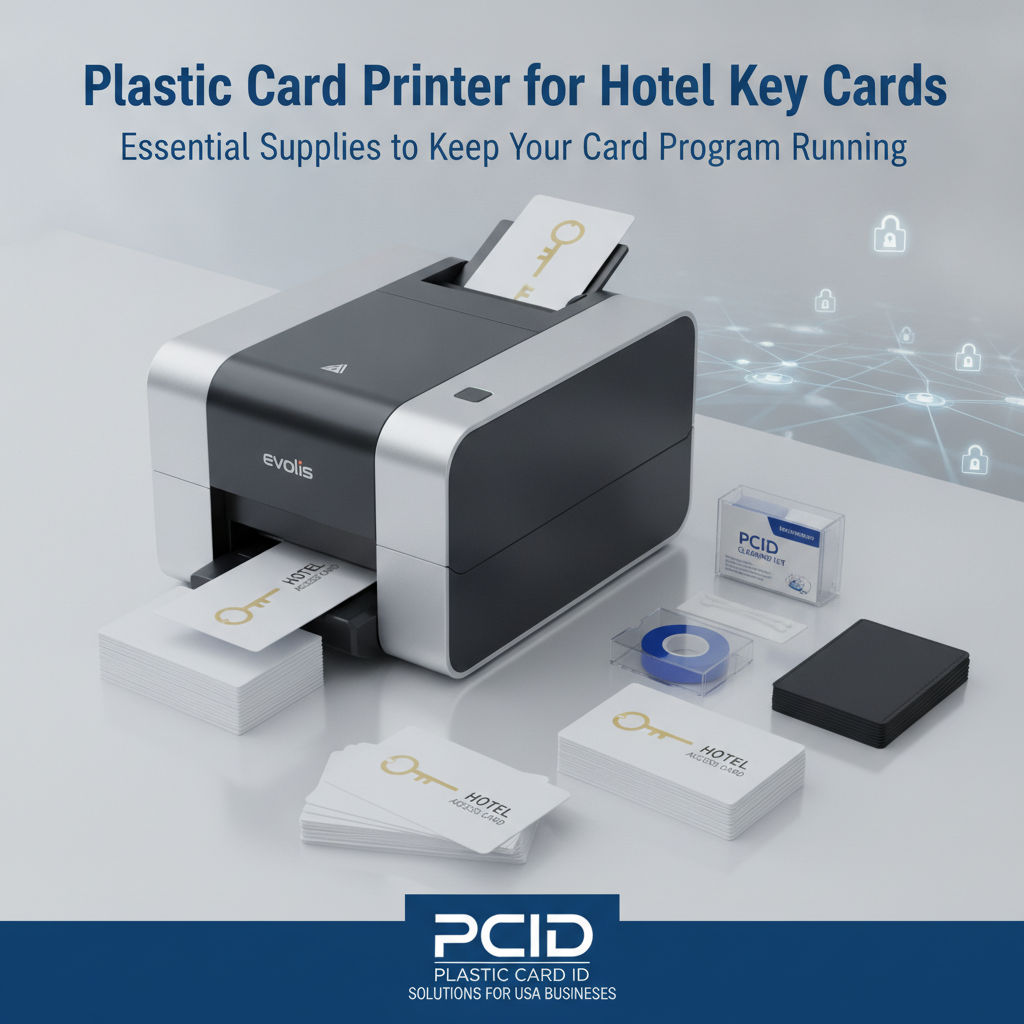 Purchasing a printer is the first step. Keeping it running at peak performance requires a consistent supply of the right consumables, and running out of ribbon mid-shift is not an option at a hotel front desk. Plastic Card ID supplies all the consumables hotels need to maintain an uninterrupted card printing operation, sourced from the same manufacturers that produce the printers themselves.
Printer Ribbons for Hotel Key Card Applications
YMCKO ribbons are the standard choice for full-color hotel key card printing. The formulation - Yellow, Magenta, Cyan, Black, and Overlay - produces vibrant graphics with a protective topcoat layer that helps the printed surface resist wear, scratching, and fading. For hotels that print cards at high volume with minimal graphic variation, monochrome ribbons offer a cost-effective alternative when only black text or simple graphics are needed.
Ribbon yield varies by model and print coverage, so CPE recommends calculating your average monthly card volume and ordering ribbon stock accordingly. Keeping at least two to three ribbon rolls in reserve ensures you're never caught short during a busy weekend or group arrival event.
Cleaning Kits and Printer Maintenance
Card printers are precision devices, and dust, card debris, and ribbon residue accumulate inside the printer mechanism over time. Regular cleaning extends printer lifespan, maintains print quality, and reduces the risk of card jams during high-demand periods. Plastic Card ID supplies cleaning kits - including cleaning cards and swabs - designed specifically for the printer models they carry.
Most manufacturers recommend running a cleaning cycle every time a new ribbon is installed, at minimum. Hotels that print high volumes daily may benefit from more frequent cleaning intervals. Establishing a simple maintenance schedule protects your investment and keeps card output looking sharp for every guest.
Card Carriers, Sleeves, and Accessories
Beyond the printer and its consumables, Plastic Card ID stocks card carriers and protective sleeves that extend the usable life of hotel key cards and protect them during guest use. Card carriers - the small cardboard or plastic holders that accompany room keys - also serve as a branding opportunity and a place to communicate room numbers, checkout times, or WiFi credentials without printing that information on the card itself.
Input hoppers and card feeders are available as accessories for printers that support larger-capacity card loading, reducing the frequency of manual card reloading during high-volume check-in periods. Contact 800.835.7919 to confirm which accessories are compatible with your specific printer model before placing an order.
Buyer's Guide: Choosing the Right Hotel Key Card Printer
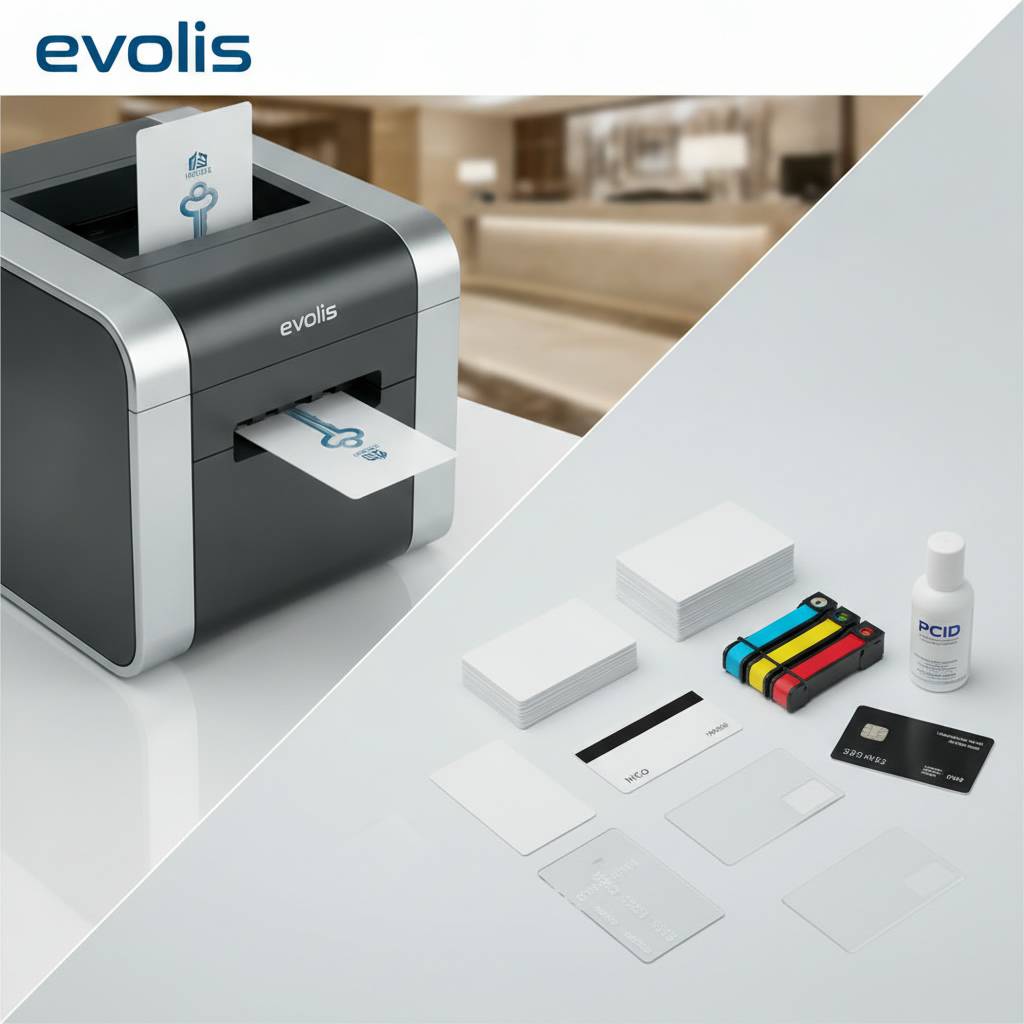 The market for card printers spans a wide price and capability range, and the best printer for your hotel isn't necessarily the most expensive one - it's the one that matches your actual volume, encoding requirements, and operational workflow. Here's a practical framework for making the right call.
Volume: The Starting Point for Every Decision
Before evaluating any printer, calculate your actual monthly card volume. Include guest check-in cards, staff access credentials, replacement cards for demagnetized keys, and any special event or group cards. That total number is your baseline, and it drives every other decision in the selection process.
- Under 1,000 cards per year: The Evolis Badgy200 is a cost-effective entry point for small boutique properties with minimal card volume.
- 1,000 to 3,000 cards per month: The Evolis Zenius handles this range comfortably with encoding upgrade options available.
- 3,000 to 6,000 cards per month: The Evolis Primacy2 adds dual-sided capability and higher throughput for full-service hotels.
- High-volume or premium output: The Evolis Agilia delivers edge-to-edge quality at higher production rates for resort and luxury properties.
- Event-driven burst volume: The Matica Event Printer handles rapid, high-speed card production for conference centers and event-heavy properties.
Encoding Compatibility: Know Before You Buy
Check with your lock system vendor or property management system (PMS) provider to confirm the encoding format your lock system requires. Magnetic stripe track configuration, coercivity level, and smart card chip type should all be documented before selecting a printer. Compatibility issues discovered after purchase create costly delays and, in some cases, require hardware returns or upgrades that could have been avoided with upfront verification.
CPE has helped thousands of hotels navigate this exact question. If you're unsure what your system requires, bring the printer model, lock system brand, and PMS software name to the conversation - that's usually enough information to identify the right encoder configuration from the start.
Total Cost of Ownership Beyond the Purchase Price
The printer purchase price is just one component of the total cost of running an in-house card program. Ribbons, cleaning kits, blank card stock, and occasional maintenance all factor into the ongoing cost. For most hotels, the total cost per card produced in-house is significantly lower than purchasing pre-printed cards from an outside vendor - especially when you factor in the elimination of rush shipping fees and the cost of carrying excess inventory to avoid stockouts.
A rough calculation for mid-size hotels typically shows break-even on in-house printing within the first year of operation, with meaningful savings accumulating in subsequent years. The operational control gained - print on demand, immediate encoding, custom personalization - adds value that's harder to quantify but equally real.
Frequently Asked Questions About Hotel Key Card Printing
Hotels new to in-house card printing tend to share a common set of questions. The answers below address the most common points of uncertainty and should help clarify what to expect as you move toward setting up your own card printing operation.
Can I use my own card stock with any printer?
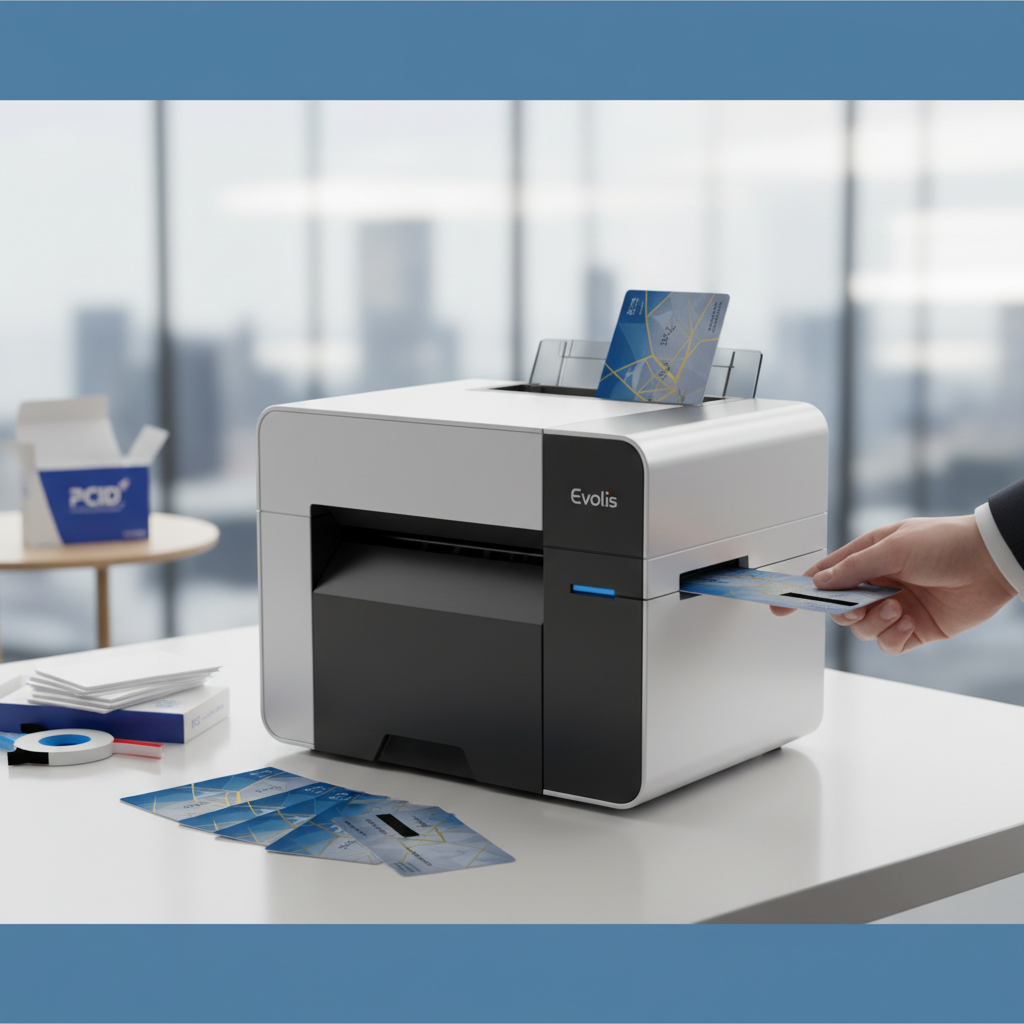
Most card printers are designed to work with standard CR80 PVC card stock - the same size as a standard credit card. However, printer manufacturers typically specify approved card stock types, and using off-specification cards can affect print quality, jam the card feed mechanism, or void the printer warranty. Purchasing card stock directly from Plastic Card ID ensures compatibility with the printer model you're running and eliminates guesswork from an otherwise simple supply decision.
Blank key card stock is available in magnetic stripe and smart card chip varieties, in both glossy and matte finishes depending on your branding requirements. The team at CPE can confirm the right blank card spec for your printer and encoding combination.
How long does it take to print and encode a hotel key card?
Modern card printers are fast. Most mid-range models like the Evolis Primacy2 can produce a fully printed and encoded card in roughly 20-30 seconds, which means a front desk agent can produce a guest's room key within a minute of initiating the print job - even accounting for software processing time. High-speed models and industrial printers reduce that time further, making them appropriate for group check-ins or event badge printing where volume matters more than individual speed.
What software do I need to print hotel key cards?
Card design and printing software varies by printer brand and model. Evolis printers are typically compatible with Evolis Premium Suite software, which handles card design, database integration, and print queue management. Fargo and Zebra printers use their own software ecosystems. For encoding, your lock system or PMS provider will typically supply or specify the encoding software that interfaces with the printer's encoding module.
When you purchase through Plastic Card ID, you're getting hardware that's been selected for real-world compatibility with common hospitality software environments. That institutional knowledge makes a measurable difference in how smoothly your setup process goes.
Partner with Plastic Card ID for Your Hotel Key Card Printing Program
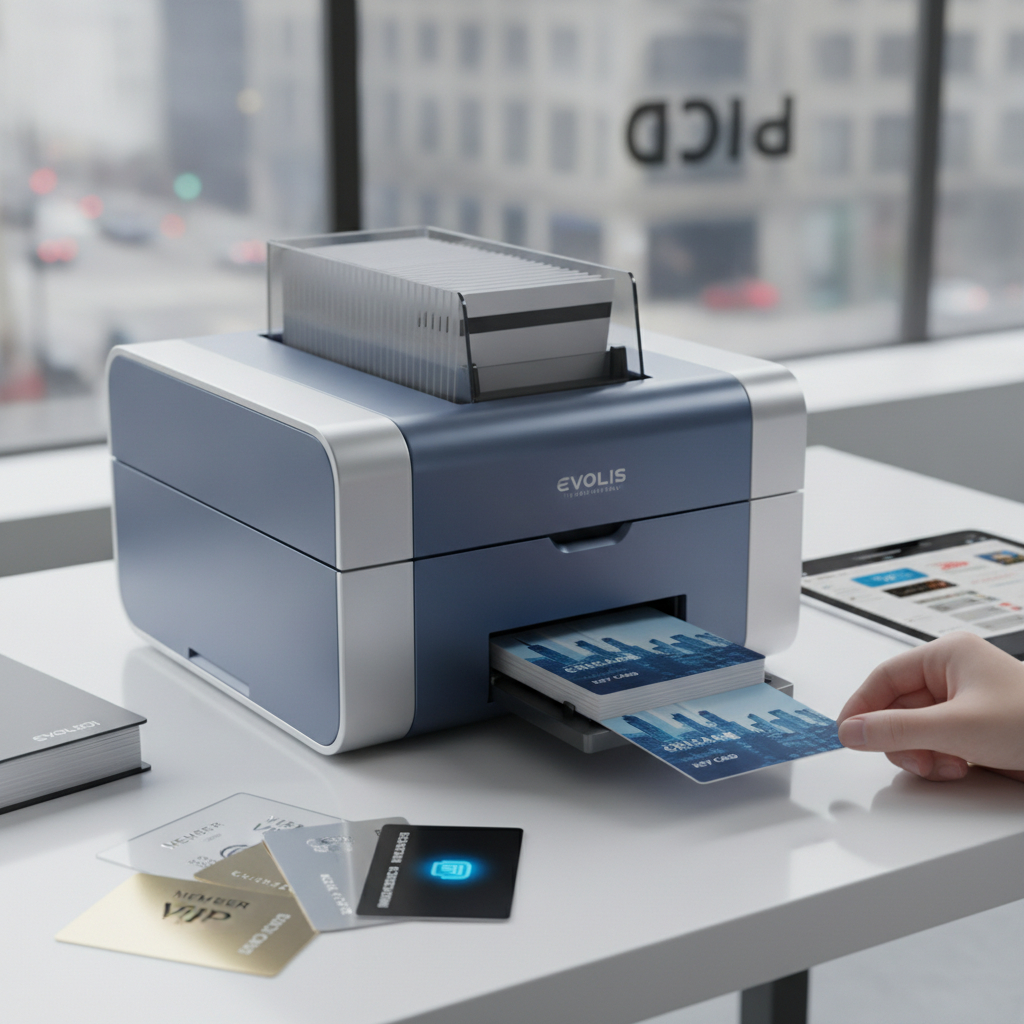 More than 100,000 businesses across the United States have trusted Plastic Card ID to supply their card printing hardware and consumables - and the hospitality sector represents a significant share of that customer base. Hotels, resorts, boutique properties, conference centers, and extended-stay facilities all rely on CPE for the equipment that keeps their front desk operations running smoothly.
The right plastic card printer for hotel key cards isn't a commodity purchase. It's a piece of operational infrastructure that affects every guest check-in, every staff access credential, and every amenity interaction where a card is required. Getting that selection right from the start saves time, money, and operational headaches that no front desk team should have to deal with.
A Trusted Supplier with 25 Years of Experience
Plastic Card ID brings over 25 years of card printing expertise to every customer interaction. That depth of experience means the team understands not just which printer has the right spec sheet, but which models hold up under daily hotel use, which ribbon formulations work best for key card applications, and which encoding configurations are most reliably compatible with the lock systems you're most likely to encounter in the field.
Experience is the difference between a supplier who sells you a product and one who helps you build a solution. CPE has consistently been the latter for hospitality customers across the country, and that reputation has been earned through decades of getting the details right.
Everything You Need, All in One Place
From the printer itself to the ribbon, the cleaning kit, the blank card stock, the encoding module, the input hopper, and the card carrier - Plastic Card ID stocks everything required to run a complete, professional hotel key card program. There's no need to piece together a program from multiple vendors with inconsistent support and varying compatibility guarantees.
A consolidated supply relationship simplifies purchasing, ensures component compatibility, and gives your operations team a single point of contact for questions, reorders, and troubleshooting. That kind of operational simplicity has real value in a hospitality environment where the priority is always the guest experience, not supply chain management.
Ready to Get Started?
Call 800.835.7919 today to speak with a card printing specialist who can help you identify the right printer, encoding configuration, and consumable supplies for your hotel's specific needs. Whether you're setting up your first in-house card program or upgrading aging equipment, CPE has the expertise and inventory to move the process forward quickly.
Take control of your hotel key card program. Stop waiting on outside vendors. Start printing exactly what you need, when you need it - with the confidence that comes from working with a supplier who knows this space as well as you know your property.
Contact Plastic Card ID today at 800.835.7919 and let's build the right card printing solution for your property together.