Card Printer Cost Per Card Breakdown: What to Expect
Table of Contents []
- Understanding Card Printer Cost Per Card: A Complete Breakdown from Plastic Card ID
- What Actually Goes Into the Cost Per Card Calculation
- Encoding Add-Ons: Magnetic Stripe, Smart Chip, and What They Cost
- In-House Printing vs. Outsourcing: The Real Cost Comparison
- Matching Printer Model to Volume for Optimal Cost Per Card
- Frequently Asked Questions About Card Printer Cost Per Card
- Why Plastic Card ID Is the Right Partner for Your Card Program
- Start Building Your Card Program with Plastic Card ID Today
Understanding Card Printer Cost Per Card: A Complete Breakdown from Plastic Card ID
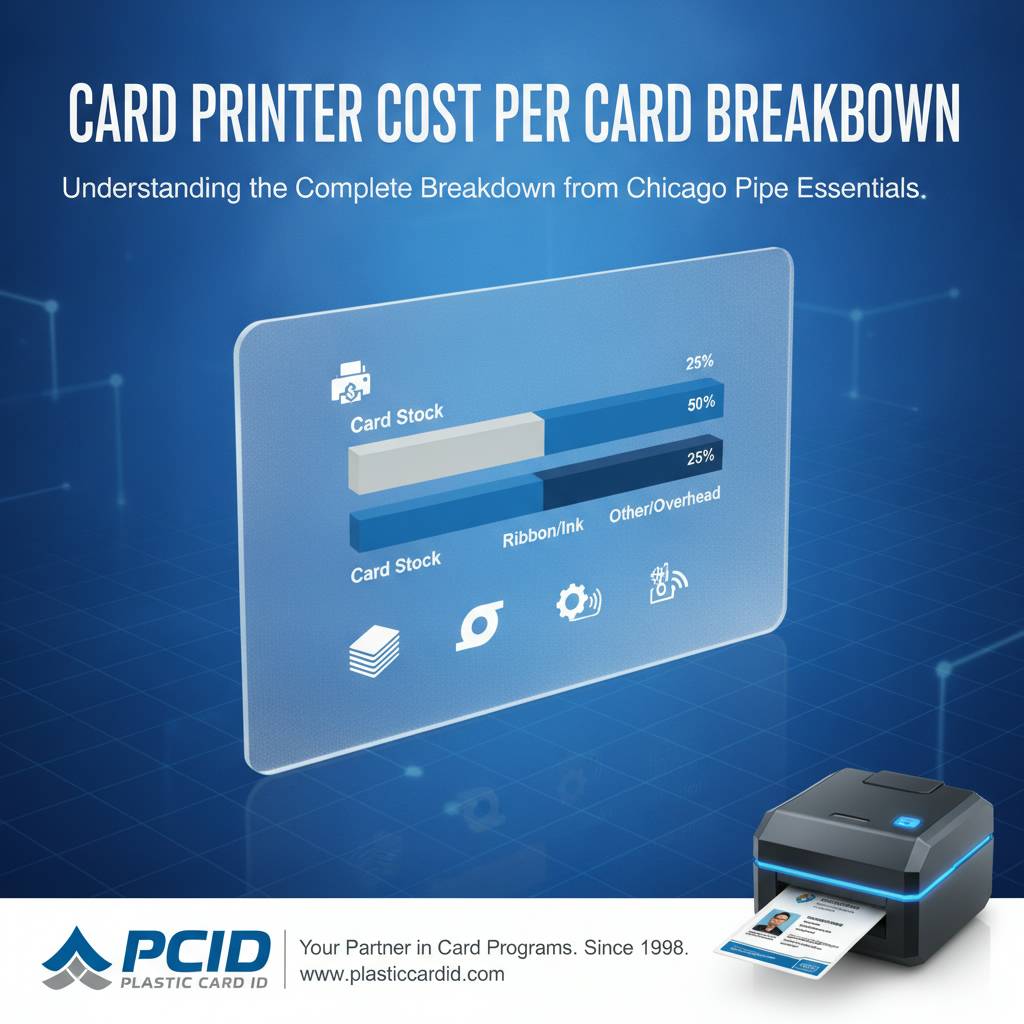 Most buyers ask the wrong question first. They look at the sticker price of a card printer and decide from there - but the real financial story lives inside every single card that machine produces. Understanding your true cost per card is what separates a smart purchasing decision from an expensive lesson learned over months of operation.
Whether you're running an HR department printing employee badges, a university issuing student IDs, or a hotel managing key card production, the math behind each card tells you far more than the upfront hardware price ever will. At Plastic Card ID, we've spent over 25 years helping more than 100,000 businesses across the United States build card programs that actually pencil out - financially and operationally.
| Printer Tier | Example Model | Volume Range | Est. Cost Per Card |
|---|---|---|---|
| Entry-Level | Evolis Badgy200 | Under 1,000/year | $0.75-$1.50 |
| Mid-Range | Evolis Primacy2 | 1,000-6,000/month | $0.35-$0.65 |
| High-Volume | Evolis Agilia / Matica | 6,000/month | $0.18-$0.40 |
What Actually Goes Into the Cost Per Card Calculation
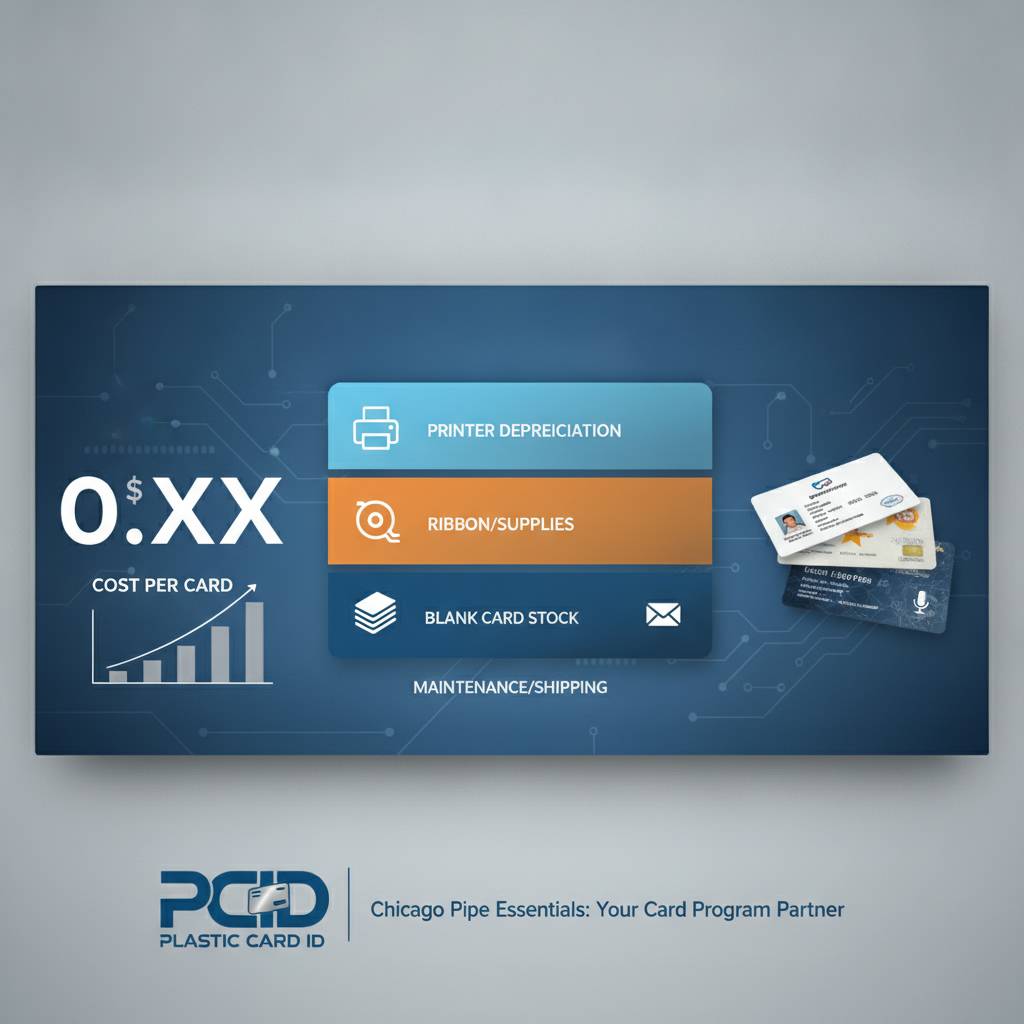
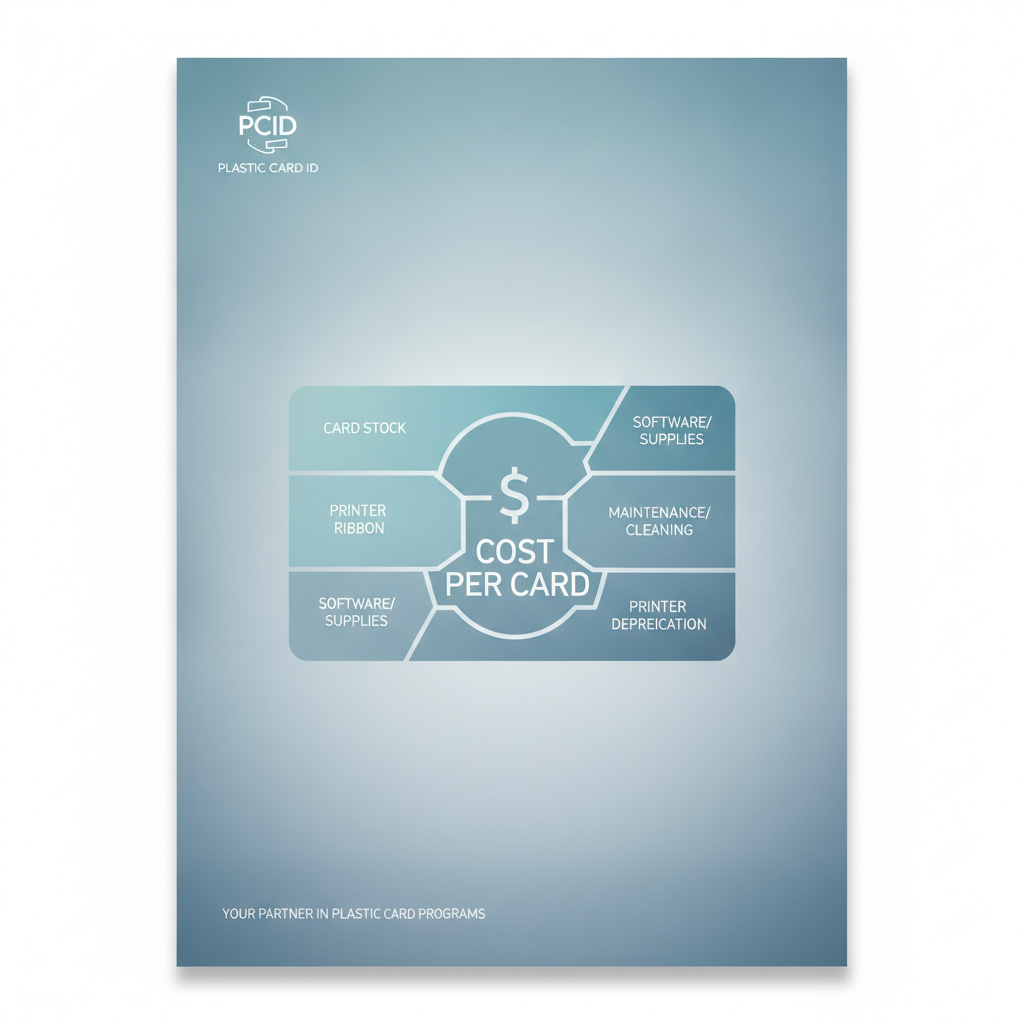 Strip away the marketing language and you're left with four core cost drivers: the printer hardware amortized over its usable lifespan, consumable ribbons, blank PVC card stock, and any encoding or lamination added to the card. Each of these layers stacks onto the next, and ignoring even one component will skew your numbers significantly.
The good news? Once you understand how these variables interact, you can engineer a card program that hits your target budget with precision. CPE carries the hardware, ribbons, cleaning kits, and accessories to cover every scenario - so you're not hunting across five different vendors to piece a program together.
Hardware Amortization: Spreading the Printer Cost Over Time
A printer isn't a one-time expense in any meaningful operational sense. It's a capital investment that pays dividends across thousands - sometimes hundreds of thousands - of cards. Dividing the purchase price by your expected card volume over the printer's life gives you the hardware component of your cost per card.
An entry-level unit like the Evolis Badgy200 might run $300-$500. If you print 500 cards per year and keep the machine for five years, your hardware contribution is roughly $0.12-$0.20 per card. A mid-range Evolis Primacy2 at $900-$1,400 spread across 60,000 cards over two years drops that hardware cost below $0.03 per card. Volume is the great equalizer in hardware amortization.
Higher-tier systems like the Evolis Agilia or Matica Event Printer carry larger upfront costs, but organizations running thousands of cards monthly find those costs diluted rapidly. The math rewards throughput - consistently and dramatically.
Ribbon Costs: The Biggest Variable in the Equation
If there's one line item that surprises new card program managers the most, it's ribbon consumption. Ribbons are the single largest ongoing consumable expense for most card printing operations, and the type you choose affects both quality and cost per card substantially.
YMCKO ribbons - full-color panels with a clear overlay - are the standard for professional ID cards. A typical YMCKO ribbon yields 200-500 prints depending on the model, and ribbons range from $35-$120 depending on brand and yield. Do that math: a 500-print ribbon at $60 means $0.12 per card just for the ribbon. For high-volume programs, monochrome ribbons drop that figure dramatically, sometimes to $0.02-$0.05 per card when printing single-color text or barcodes.
Specialty ribbons - silver, gold, holographic overlay - carry premium pricing but serve specific branding or security functions. The key is matching ribbon type to actual card requirements rather than defaulting to full-color for every application.
Blank Card Stock and Its Role in Per-Card Costs
Standard CR80 PVC cards - the size of a credit card - run $0.03-$0.15 per card when purchased in quantities of 500 or more. Composite cards with higher durability or pre-printed designs push that number higher. Buying card stock in bulk is one of the easiest ways to reduce overall cost per card without changing anything about your printing process.
Cards with magnetic stripe pre-encoding, proximity chip technology, or special surface coatings carry higher base costs but may eliminate the need for certain encoding upgrades on the printer side. Understanding what you need on the card before you buy helps CPE match you to the right hardware and supply combination from the start.
Encoding Add-Ons: Magnetic Stripe, Smart Chip, and What They Cost
A basic printed card is just one version of what modern card programs produce. Access control badges, hotel key cards, loyalty program cards, and smart ID credentials all require data encoding - and that encoding capability lives in hardware modules that affect both initial printer cost and per-card production time.
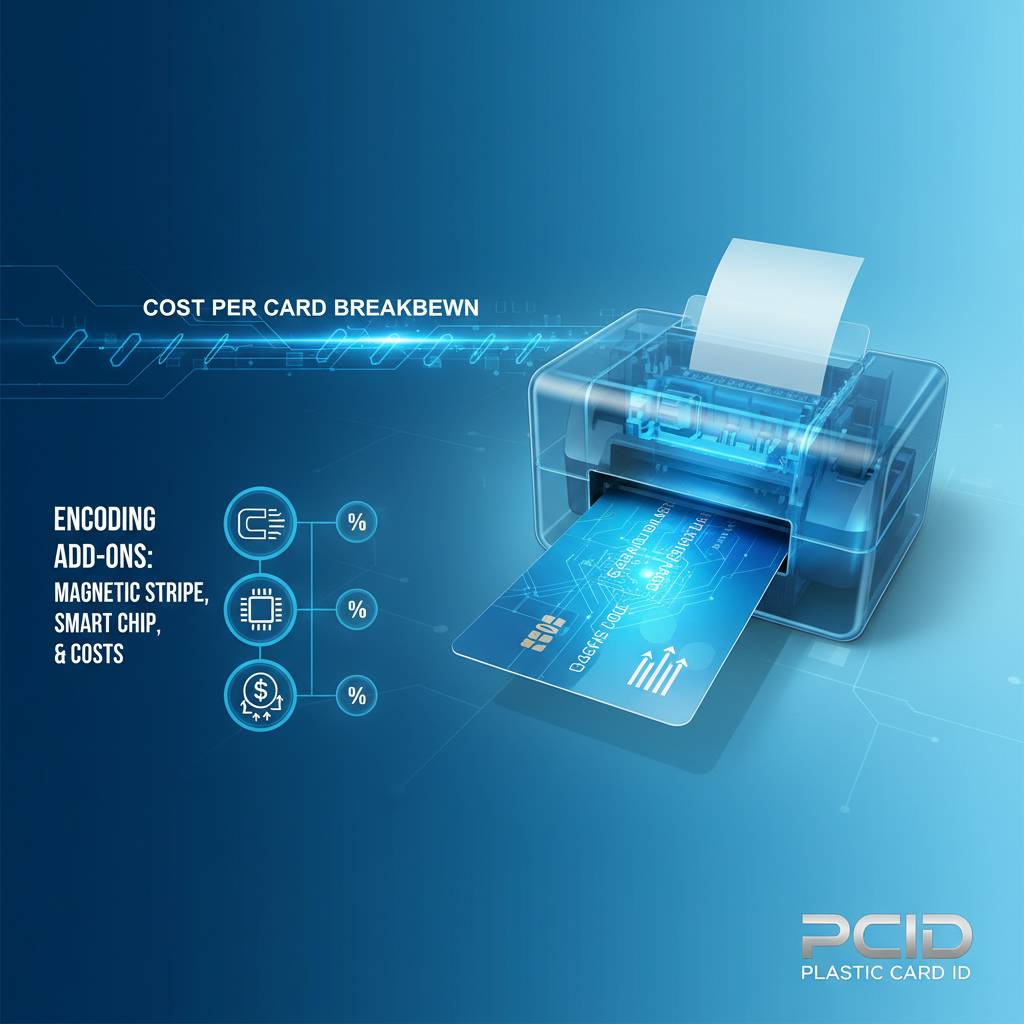
Understanding encoding costs upfront prevents budget surprises later. Whether you need a magnetic stripe encoder, a contact smart chip module, or contactless RFID capability, each adds to both the printer price and the per-card cost in ways worth calculating before you commit to a system.
Magnetic Stripe Encoding Costs
Magnetic stripe encoding is the most common upgrade for loyalty cards, hotel keys, and access control programs. The encoder module itself typically adds $100-$300 to a printer's base price depending on the model. The cards themselves with a pre-applied magnetic stripe add roughly $0.05-$0.15 per card to blank card stock costs.
The operational cost of encoding is essentially zero beyond the hardware - there are no additional consumables involved in writing data to a magnetic stripe. For organizations printing hotel key cards or member loyalty cards in volume, this remains one of the most cost-effective encoding options available. Evolis mid-range models and Fargo units both support magnetic stripe encoding through factory-installed or field-installable modules.
Smart Chip and Contactless RFID Encoding
Smart chip encoding - both contact and contactless - carries higher hardware costs and higher per-card costs for the encoded card stock, but delivers significantly more data capacity and security features. Contact smart card encoders add $300-$700 to printer costs, while contactless RFID modules vary widely based on frequency and standard supported.
The per-card cost for smart chip card blanks ranges from $0.50-$3.00 or more depending on chip type, which makes accurate volume forecasting critical before investing in this path. For enterprise access control and government-level ID programs, though, that cost per card is often fully justified by the security and functionality gains.
Lamination Modules and Security Overlaminates
Lamination dramatically extends card life and adds a visual security layer that's difficult to replicate or tamper with. Inline lamination modules - available for mid-to-high-range Evolis, Fargo, and Zebra printers - apply a thin film over the printed surface as part of the same production pass. This adds $400-$1,200 to the printer system cost depending on module type.
Per-card lamination cost runs $0.10-$0.30 per card for standard overlaminates, with holographic or custom-designed security laminates running higher. For organizations where card durability or anti-counterfeiting is critical - government IDs, high-security access badges - lamination is a cost-effective security investment when you factor in card replacement savings alone.
| Feature | Hardware Add-On Cost | Per-Card Impact |
|---|---|---|
| Magnetic Stripe | $100-$300 | $0.05-$0.15 |
| Smart Chip (Contact) | $300-$700 | $0.50-$3.00 |
| Lamination Module | $400-$1,200 | $0.10-$0.30 |
In-House Printing vs. Outsourcing: The Real Cost Comparison
 Plenty of organizations default to outsourcing card production without ever running a true cost comparison. Vendors who produce cards externally charge per-card rates that include their own overhead, profit margin, and the inefficiency of minimum order quantities. In-house printing consistently wins on a per-card basis once volume exceeds a fairly modest threshold.
Beyond raw cost, in-house printing gives organizations control they simply can't purchase from an outside vendor - print on demand, instant personalization, same-day issuance, and real-time encoding of access credentials or loyalty data. CPE has helped businesses across retail, healthcare, education, hospitality, and security-focused industries make this shift and recapture significant ongoing cost.
The Break-Even Volume Threshold
For most card programs, the break-even point where in-house printing becomes cheaper than outsourcing falls somewhere between 500 and 1,500 cards per year - depending on the complexity of the card design and the outsourcing vendor's pricing. After that break-even point, every card printed in-house is pure savings compared to the outside vendor rate.
Organizations printing employee ID badges for a company of 50 people - with annual turnover and replacement cards factored in - can typically reach break-even within 12-18 months of purchasing an entry-level system. Larger organizations hit that threshold much faster, often within weeks of deployment.
Hidden Costs of Outsourcing Nobody Talks About
The per-card price from an outside vendor is rarely the full story. Minimum order requirements mean organizations often pay for more cards than they need. Rush orders for immediate replacements carry premium surcharges. Shipping costs add up across multiple orders annually. And perhaps most significantly, the time cost of waiting on outside production is a genuine operational liability for programs where cards are needed immediately.
A new employee waiting three days for a badge that grants building access is costing your organization productivity, IT workarounds, and management time - none of which appears on the card vendor's invoice but all of which is a real business expense. In-house printing eliminates these friction points entirely.
Buyer Tip: Calculating Your Own Break-Even Point
- Estimate your annual card volume, including new issues, replacements, and seasonal spikes.
- Get a per-card quote from your current or prospective outsource vendor, including minimum orders and shipping.
- Calculate your in-house cost per card using hardware amortization, ribbon cost, and blank card stock costs.
- Divide the printer system cost by the difference in per-card pricing to find your break-even card count.
- Add the value of on-demand printing speed, personalization capability, and encoding control as qualitative factors.
This exercise rarely takes more than 30 minutes and frequently reveals that in-house printing pays for itself far sooner than buyers expect. CPE can walk you through this calculation for your specific program at no obligation - call 800.835.7919 and we'll run the numbers with you.
Matching Printer Model to Volume for Optimal Cost Per Card
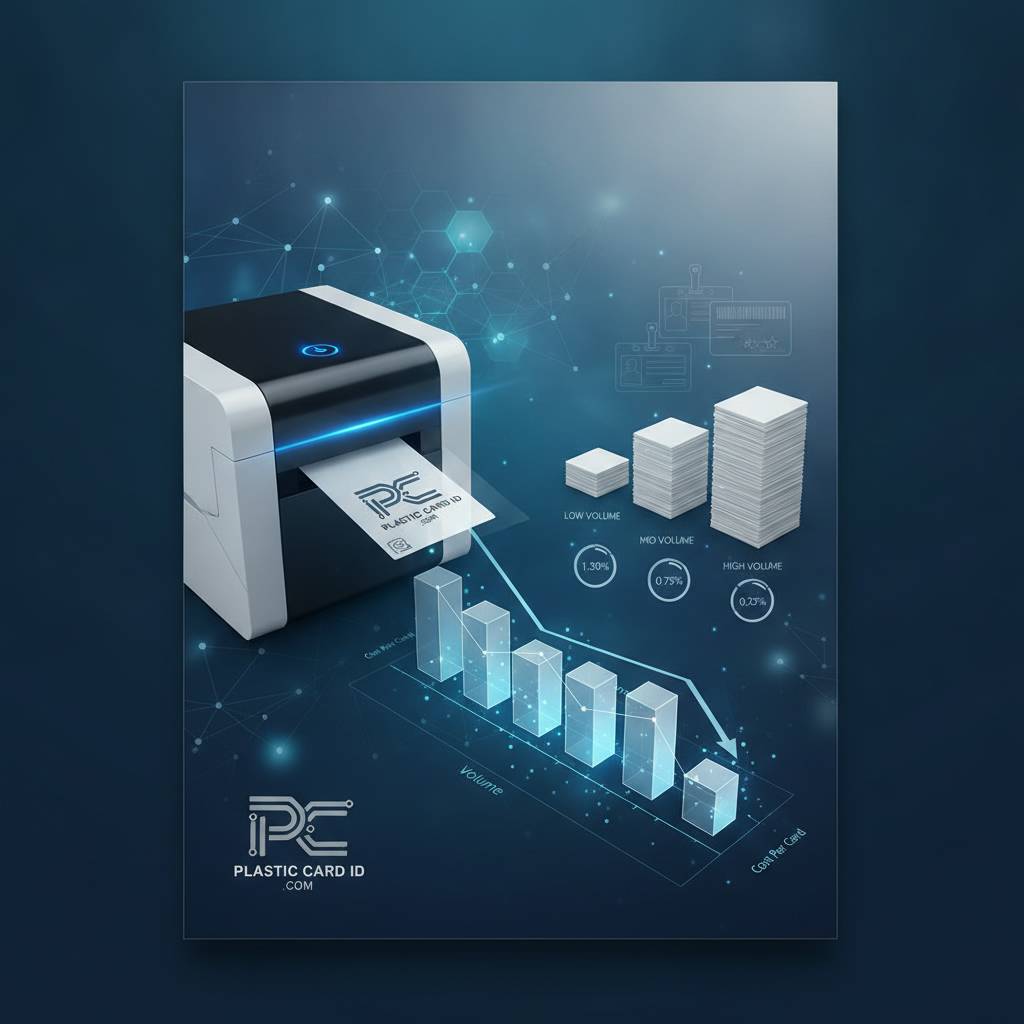 One of the most common cost mistakes organizations make is mismatching printer capability to actual production volume. Buying an entry-level printer for a high-volume program means excessive ribbon waste, faster mechanical wear, and ultimately higher per-card costs through increased maintenance and early replacement. The reverse - buying an industrial system for 200 cards a year - is simply overspending on capability you'll never use.
Right-sizing your printer to your volume is the single most impactful cost optimization decision in building a card program. Plastic Card ID carries a full spectrum of hardware precisely so every customer lands on the right tool for their actual production needs.
Entry-Level: Evolis Badgy200 for Low-Volume Programs
The Evolis Badgy200 is purpose-built for organizations printing fewer than 1,000 cards per year - small businesses, nonprofits, clubs, or departments within larger organizations that manage their own badge printing independently. It's compact, straightforward to operate, and delivers professional-quality color cards without requiring a dedicated print operator.
At this volume, per-card costs run higher proportionally because hardware amortization is spread across fewer cards. But for low-volume programs, the alternative - outsourcing - is almost always more expensive once you factor in minimum orders and shipping. The Badgy200 makes in-house printing accessible at exactly the right entry point.
Mid-Range: Evolis Zenius and Primacy2 for Growing Programs
The Evolis Zenius and Primacy2 represent the sweet spot for the majority of business card programs - organizations printing 1,000 to 6,000 cards per month. The Primacy2 in particular supports dual-sided printing and optional magnetic stripe encoding, making it a highly capable all-in-one solution for employee badges, access cards, and membership programs.
At mid-range volumes, the cost per card drops dramatically compared to entry-level systems. Higher-yield ribbons become available, hardware amortization spreads more efficiently, and the faster print speed reduces the labor time associated with large production runs. This tier also supports cleaning kit maintenance cycles that protect ribbon yield and print head longevity - directly impacting long-term cost per card.
High-Volume and Specialty: Evolis Agilia, Fargo, Zebra, and Matica
For organizations that need edge-to-edge premium output, robust security features, or high-speed on-site badge production, the upper tier delivers. The Evolis Agilia produces exceptional full-bleed card quality at production volumes that would overwhelm mid-range systems. Fargo and Zebra printers bring deep security feature integration for government, enterprise, and access control programs. The Matica Event Printer is specifically engineered for on-site, real-time credential printing at large events.
At these volumes and price points, per-card costs reach their lowest achievable levels - sometimes below $0.20 per card for high-volume color printing when all factors are calculated together. The capital investment is larger, but the ongoing operational economics are compelling for any organization printing at serious scale.
Frequently Asked Questions About Card Printer Cost Per Card
After more than two decades in this industry, the questions that surface most often aren't about which printer has the highest resolution - they're about money. Specifically, how much does it actually cost to print a card, and how do you keep that number as low as possible over time.
The following questions represent what CPE hears most frequently from businesses evaluating in-house card printing programs for the first time or looking to optimize programs already in operation.
How do cleaning kits affect cost per card?
Cleaning kits are a small cost that prevents a large one. Regular cleaning of print heads and card transport mechanisms preserves ribbon adhesion quality, reduces misprints, and extends print head life. A misprinted card wastes both the ribbon panel used and the blank card stock - meaning skipping cleaning actually raises your per-card cost through increased waste.
Most manufacturers recommend a cleaning cycle every 500-1,000 cards, and cleaning kit costs are minimal - typically $10-$40 per kit depending on the system. Factoring cleaning into your maintenance schedule is one of the easiest ways to protect per-card economics over the life of a printer.
Does dual-sided printing significantly increase cost per card?
Dual-sided printing uses more ribbon - specifically, a second pass of ribbon panels for the reverse side. However, many dual-sided ribbons are designed to optimize coverage across both sides, and the additional cost is typically $0.05-$0.20 per card compared to single-sided printing. For cards requiring back-side printing of barcodes, contact information, or terms of use, the functional necessity usually justifies the cost differential easily.
The alternative - printing one side and applying a label to the reverse - introduces a manual step, a separate supply item, and an appearance that looks less professional than a printed card. Dual-sided printing is almost always the smarter operational choice for cards that need information on both faces.
What's the best way to reduce ribbon waste?
- Use monochrome ribbons for cards that don't require full-color printing - the savings per card are substantial.
- Match ribbon type precisely to card design requirements rather than defaulting to YMCKO for all applications.
- Maintain consistent cleaning schedules to preserve print head contact quality and avoid wasted panels from misprints.
- Store unused ribbon in a cool, dry location away from direct light to preserve the ribbon's functional lifespan.
- Batch print cards when possible rather than printing one-off cards repeatedly, which minimizes initialization waste.
Each of these practices contributes meaningfully to lowering your ribbon cost per card. Combined, they can reduce ribbon-related expenses by 15-30% in typical programs - a significant number when multiplied across thousands of cards annually.
Why Plastic Card ID Is the Right Partner for Your Card Program
 There's no shortage of places to buy a card printer online. What's rarer is finding a supplier that combines 25 years of industry experience, a curated selection of professional-grade hardware from the market's leading brands, and the operational knowledge to help you build a card program that makes financial sense from day one. Plastic Card ID has done exactly that for more than 100,000 customers across every industry in the United States.
The brands in the CPE lineup - Evolis, Fargo, Zebra, and Matica - aren't there by accident. They represent the best combination of print quality, feature depth, reliability, and consumable availability in the market. Every printer we carry is backed by a full range of compatible ribbons, cleaning kits, lamination modules, encoding options, and card carriers and sleeves to keep your program running without supply disruptions.
A Complete Supply Ecosystem, Not Just Hardware
A card printer without reliable ribbon supply is a paperweight. CPE stocks YMCKO full-color ribbons, monochrome ribbons in multiple colors, specialty ribbons including holographic and metallic formats, and cleaning kits for every major system we carry. This matters operationally - you're not hunting across multiple vendors when you run low on supplies mid-production.
One supplier, complete program support. Input hoppers, card carriers, sleeves, encoding modules, and lamination consumables are all available through Plastic Card ID, which simplifies purchasing, streamlines your supply chain, and ensures compatibility between every component in your card production workflow.
Experience Across Every Card Program Type
Employee ID badges, student ID cards, hotel key cards, membership and loyalty cards, event credentials, access control badges - Plastic Card ID has supplied card programs of every type and scale. That breadth of experience means the guidance you get isn't generic; it's informed by the specific requirements of your program type, your volume profile, and your operational constraints.
When a hotel group needs to print key cards on-site during check-in, the solution looks different than a school district managing student ID issuance at the start of the year. Getting the right printer matched to the right application is where experience pays off - and it's exactly the kind of guidance CPE provides to every customer who calls or contacts us.
Ready to Calculate Your Card Program's True Cost?
Reach out to Plastic Card ID directly and let's build your cost-per-card calculation together. With the right hardware selection, consumable strategy, and volume planning, most organizations are surprised at how affordable professional in-house card printing actually is. Call 800.835.7919 and speak with a card printing specialist today.
Don't estimate when you can calculate. Don't outsource when you can own the process. The numbers almost always favor in-house printing once the full picture is on the table - and CPE has been putting that picture together for businesses across the country for more than 25 years.
Start Building Your Card Program with Plastic Card ID Today
 Every card you print in-house is a card you control - printed on demand, personalized to the individual, encoded with the credentials it needs, and issued the moment it's needed. That operational agility has a real dollar value that doesn't appear in any per-card cost formula, but it's felt every time someone walks up to a front desk and walks away with a credential in minutes rather than days.
The cost per card calculation is where smart card programs begin - and Plastic Card ID is the partner that helps you get it right from the very first card. With industry-leading hardware from Evolis, Fargo, Zebra, and Matica, a complete consumable supply ecosystem, and over a quarter-century of hands-on program experience, there's no better starting point for your in-house card printing journey. Call Plastic Card ID now at 800.835.7919 and let's get your program built the right way.