Entry-Level vs High-Volume Card Printers: Which Do You Need?
Table of Contents []
- Choosing the Right Card Printer: Plastic Card ID Breaks Down Every Option
- What Entry-Level Card Printers Actually Deliver
- Mid-Range Card Printers: Where Most Organizations Live
- High-Volume and Premium Output: Evolis Agilia, Fargo, and Zebra
- Frequently Asked Questions: Entry-Level vs. High-Volume Card Printers
- Card Types and Applications Supported Across the Lineup
- Why Plastic Card ID Is the Partner Your Card Program Needs
Choosing the Right Card Printer: Plastic Card ID Breaks Down Every Option
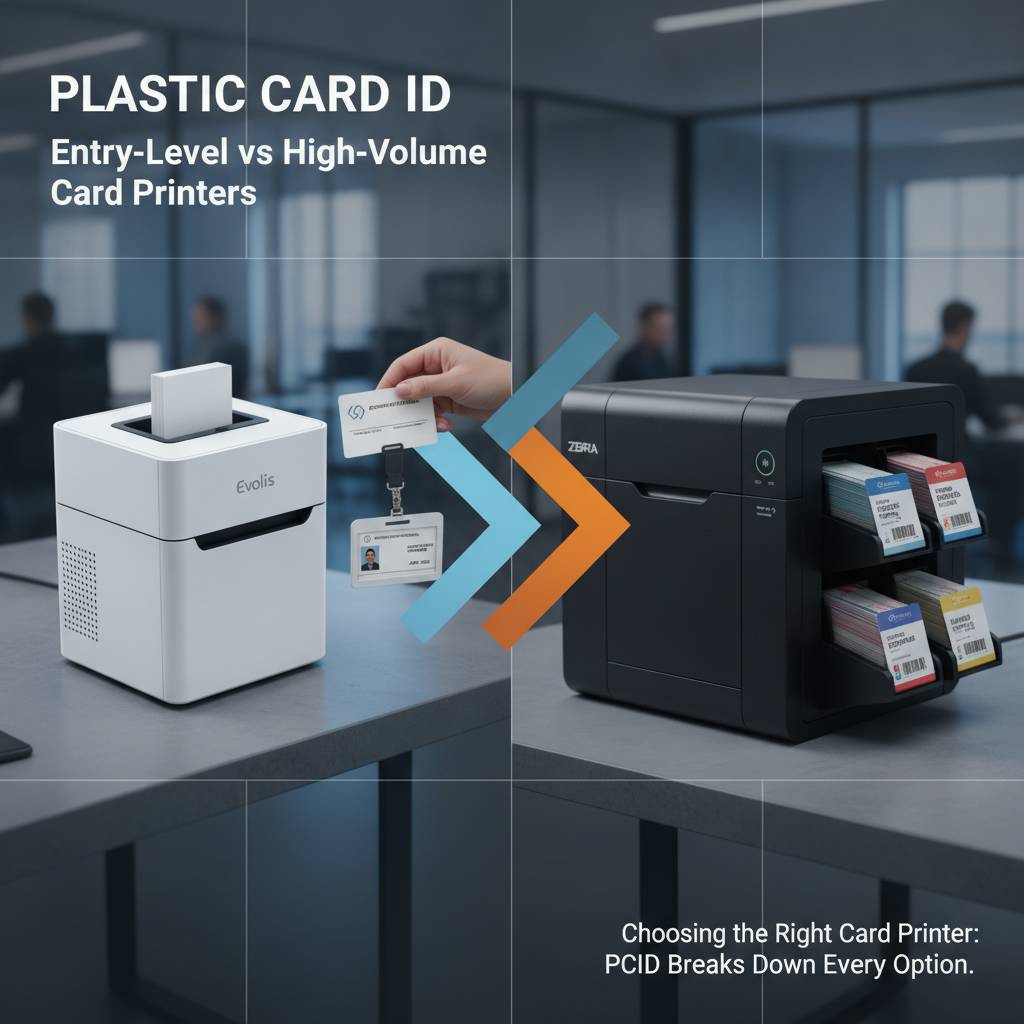 Not every organization prints the same number of cards. A small nonprofit issuing a few hundred membership badges per year has completely different needs than a university churning out thousands of student IDs each semester. That gap - in volume, in budget, in feature requirements - is exactly why choosing the right card printer matters more than most buyers initially realize. Get it wrong, and you're either overpaying for industrial capacity you'll never use or grinding a desktop unit into early failure with workloads it was never built to handle.
CPE has spent over 25 years helping businesses across the United States navigate that exact decision. With more than 100,000 customers served and a curated lineup from Evolis, Fargo, Zebra, and Matica, the team here has seen virtually every scenario imaginable. The guidance below reflects that deep experience - practical, honest, and structured to help you match the right printer to the right program from day one.
| Printer Category | Recommended Volume | Example Models | Best For |
|---|---|---|---|
| Entry-Level Desktop | Under 1,000 cards/year | Evolis Badgy200 | Small businesses, clubs, nonprofits |
| Mid-Range Workhorses | 1,000-6,000 cards/month | Evolis Zenius, Primacy2 | HR departments, schools, mid-size orgs |
| Premium Output | High-quality full-bleed printing | Evolis Agilia | Branded cards, premium credentials |
| Security-Focused ID | Variable, encoding-heavy | Fargo, Zebra | Government, enterprise, access control |
| High-Speed Event | Rapid on-site bursts | Matica Event Printer | Conferences, events, trade shows |
What Entry-Level Card Printers Actually Deliver
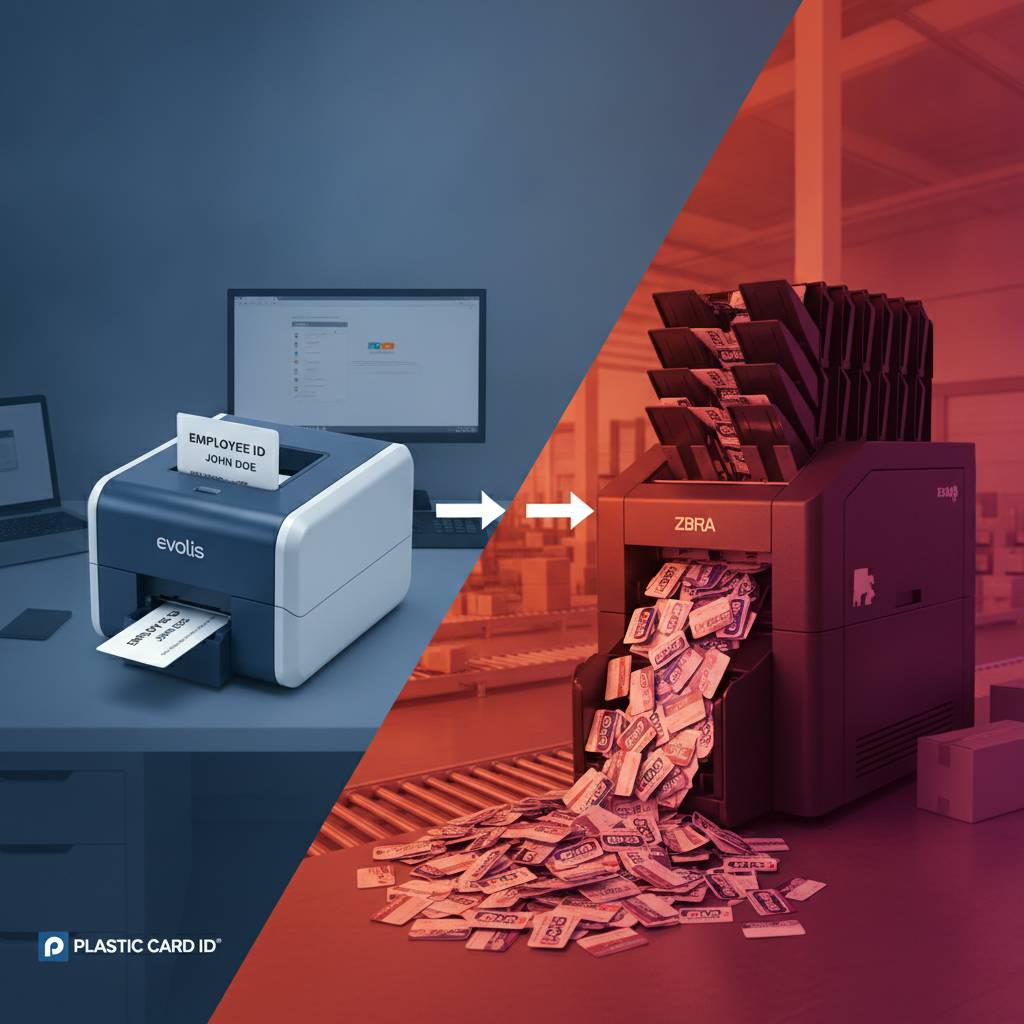 The phrase "entry-level" sometimes carries an unfair stigma - it shouldn't. Entry-level card printers like the Evolis Badgy200 are purpose-built tools, engineered for organizations that need clean, professional plastic card output without the overhead of an industrial machine. If your annual print volume stays under 1,000 cards, you genuinely don't need anything more powerful, and buying up just wastes capital.
These units shine in scenarios where print runs are small, predictable, and relatively infrequent. Think of a local gym issuing member cards, a small school district printing visitor passes, or a boutique hotel managing a modest loyalty program. The card quality is professional, the setup is approachable for non-technical staff, and the footprint on a desk is minimal. Don't underestimate what a well-matched entry-level printer can accomplish for the right use case.
The Evolis Badgy200: A Closer Look
The Badgy200 has earned its place as a go-to recommendation for low-volume buyers because it removes friction from the entire process. It comes bundled with card design software, making it accessible to teams that don't have a dedicated graphic designer. The print quality - vibrant, sharp, and durable on standard PVC cards - holds up against day-to-day handling in real-world environments.
What it doesn't have is where buyers need to be realistic. The Badgy200 isn't designed for dual-sided printing in automated batches, and it won't handle magnetic stripe encoding without upgrades. For its intended audience, those omissions are completely acceptable trade-offs for the lower price point and simpler operation.
Ribbon Types and Consumables for Entry-Level Units
Entry-level printers use the same ribbon technology as their larger counterparts - YMCKO (color with overlay) ribbons for full-color card output, and monochrome ribbons for single-color text and barcode applications. Monochrome black ribbons can print hundreds of cards per ribbon panel, making them especially cost-effective when color isn't required.
CPE supplies the full range of compatible ribbons, cleaning kits, and card stock for every supported model. Keeping a cleaning kit on hand matters more than many new buyers expect - regular cleaning of the print head and card feed rollers directly extends the useful life of any card printer, including entry-level models.
When an Entry-Level Printer Stops Being the Right Choice
Volume creep is real. Organizations frequently start small and discover that their card program grows faster than expected - more employees, more members, more events. When print jobs start backing up, when ribbons need replacing more than once a week, or when the printer runs hot during extended sessions, those are reliable signals that it's time to evaluate a step up.
The cost of under-specifying a printer is often hidden in downtime, reprints, and premature hardware replacement. A mid-range unit that handles your actual workload reliably is almost always a better long-term investment than an entry-level machine pushed beyond its design parameters. Call 800.835.7919 and the team at CPE can walk you through exactly where that threshold lies for your specific program.
Mid-Range Card Printers: Where Most Organizations Live
The mid-range category is, by a significant margin, where the majority of card printing programs actually operate. Organizations printing anywhere from 1,000 to 6,000 cards per month need hardware that can sustain that pace, support encoding options, and handle both single and dual-sided output without complaint. The Evolis Zenius and Evolis Primacy2 sit squarely in this sweet spot and represent two of the most widely deployed card printers in the country for good reason.
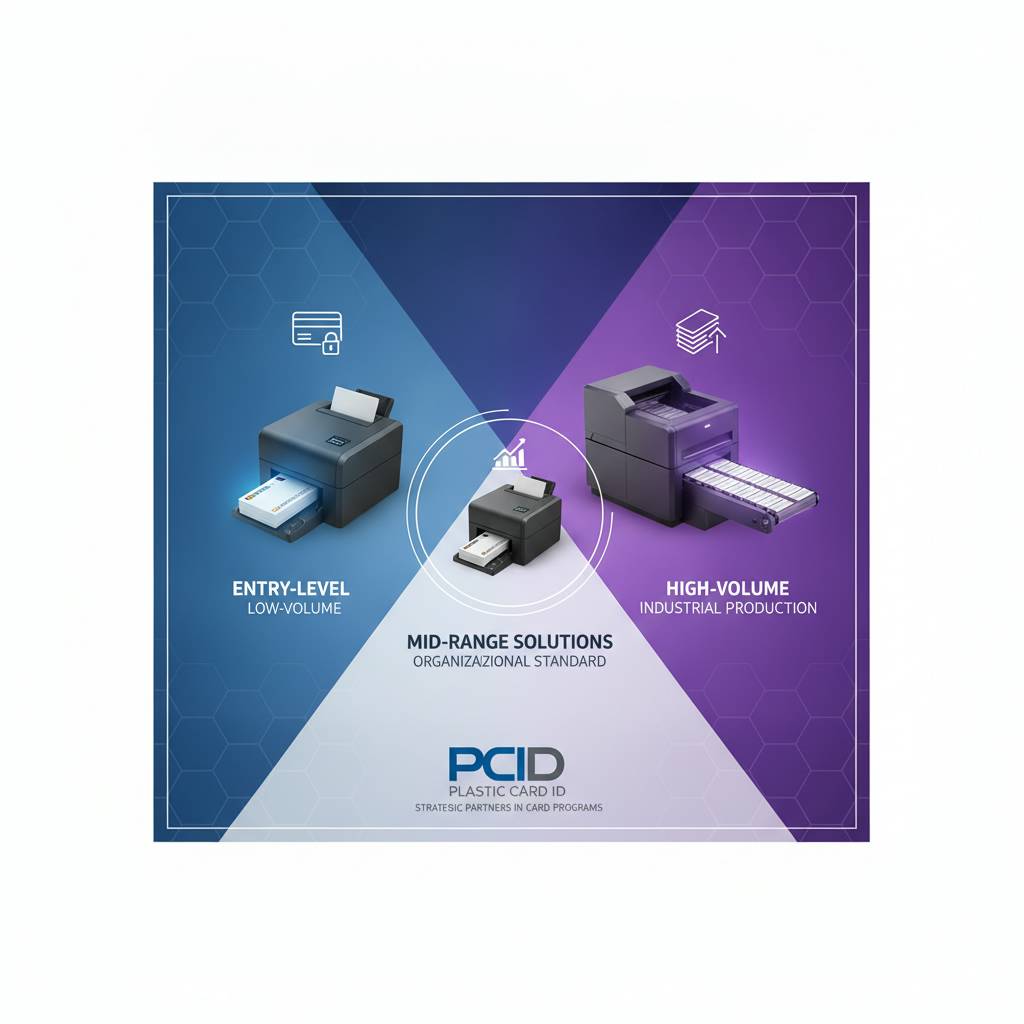
Mid-range printers introduce the features that make a card program genuinely versatile. Dual-sided printing means a single pass produces fully decorated cards - logo and name on the front, barcode or policy text on the back. Magnetic stripe encoding opens the door to access control, loyalty program tracking, and time-and-attendance integration. These aren't luxuries at this tier; they're practical tools with real operational value.
Evolis Zenius: Reliable Single-Sided Performance
The Zenius is a particularly well-balanced machine for HR departments and membership organizations that need consistent single-sided output at a pace that doesn't bog down operations. Its print speed is brisk, its card handling is reliable, and its connectivity options make integration with existing software environments straightforward. It supports magnetic stripe encoding as an upgrade, which many buyers add when building access control or loyalty programs.
Because it handles up to several hundred cards in an extended run without requiring operator intervention, the Zenius fits naturally into workflows where batches are printed periodically - onboarding days, enrollment periods, event prep. It's not glamorous hardware, but it is dependable in exactly the ways that matter when deadlines are real and the card room is busy.
Evolis Primacy2: Dual-Sided and Encoding-Ready
Step the Primacy2 into any environment where cards need information on both sides and the efficiency gains are immediately apparent. Rather than running cards through twice or managing manual flipping, the duplex module handles it in a single automated pass. For employee ID programs, student cards, or any credential carrying data on both faces, this is a significant workflow improvement.
The Primacy2 also supports magnetic stripe encoding and smart chip contact encoding, making it a strong platform for programs that need to embed data directly into the card rather than just printing it on the surface. CPE can configure units with the appropriate encoding modules at the time of purchase, so buyers receive ready-to-deploy hardware rather than needing to retrofit later.
Lamination Modules and Long-Term Card Durability
One feature mid-range buyers frequently overlook until they need it is lamination. Inline lamination modules apply a protective overlay directly during the print cycle, dramatically extending card lifespan in high-wear environments. Laminated cards resist scratches, UV fading, and daily handling abuse in ways that standard cards simply cannot match. For hospital ID badges, student IDs, or any card that lives in a wallet for years, lamination is often worth the investment.
CPE supplies lamination modules compatible with supported mid-range models, along with the corresponding lamination film stock. Understanding which overlay type suits your specific card application - holographic security laminates versus standard clear - is part of the consultation process when you work with an experienced supplier rather than guessing from a product page alone.
High-Volume and Premium Output: Evolis Agilia, Fargo, and Zebra
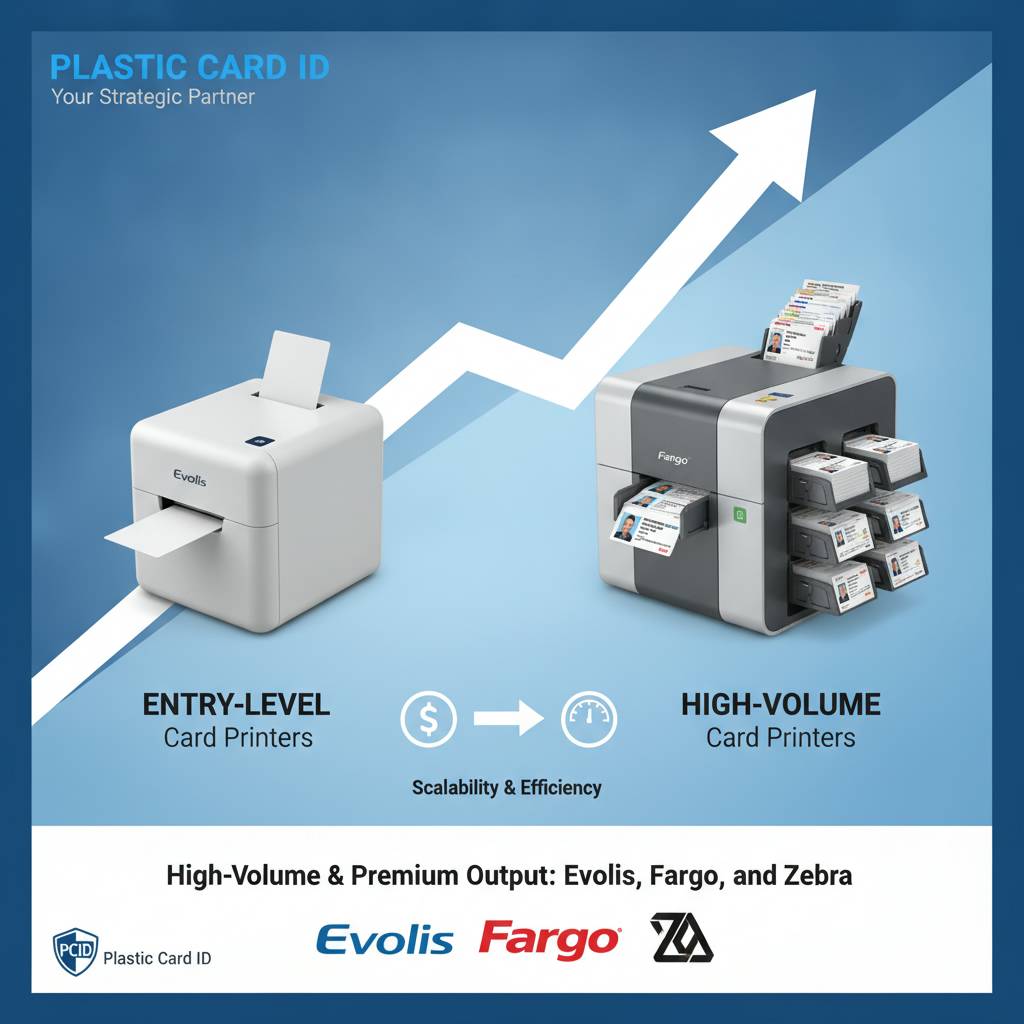 When volume climbs, print quality expectations rise, or security credentials become part of the equation, the upper tier of the card printer market delivers capabilities that mid-range hardware simply isn't engineered to sustain. The Evolis Agilia, Fargo, and Zebra platforms each address distinct high-demand scenarios with purpose-built architectures that handle the pace, the precision, and the security requirements of serious enterprise programs.
Buyers shopping in this tier are often replacing aging industrial systems, scaling a card program that has outgrown its current hardware, or launching a new program where second-rate output is never acceptable. Whatever the situation, the investment here is justified by capability - and CPE's experience matching buyers to the right machine in this category is extensive.
Evolis Agilia: Premium Edge-to-Edge Output
The Agilia is built for one primary purpose: delivering the absolute highest print quality available in a retransfer card printer. Its retransfer printing process applies color to a film that is then bonded to the card surface, producing edge-to-edge, over-the-edge imagery with a smoothness and vibrancy that direct-to-card printing cannot replicate. For branded loyalty cards, premium membership credentials, or any program where card appearance directly reflects organizational identity, the Agilia produces results that genuinely stand apart.
Retransfer printing also means the print head never contacts the card surface directly, which extends printhead life and allows printing on cards with uneven surfaces, including smart chip modules. Organizations that encode smart cards and need flawless printed output around the chip area will find the Agilia's performance particularly compelling.
Fargo and Zebra Printers: Security-First ID Programs
Fargo and Zebra have built strong reputations specifically in the security-focused ID market - government agencies, corporate enterprise environments, law enforcement, healthcare facilities where credential integrity is non-negotiable. Both brands offer robust hardware with advanced encoding support, including proximity card encoding, smart card contact and contactless options, and the kind of ruggedized build quality that survives high-demand deployment environments.
Fargo's HDP (High Definition Printing) retransfer technology and Zebra's ZXP series bring different strengths to similar problems. For buyers running an access control-integrated ID program, either platform offers the encoding flexibility and print reliability that security administrators require. The CPE team helps buyers navigate the specific feature sets to land on the right match for their security architecture.
Matica Event Printer: Credentials on Demand at Speed
The Matica Event Printer addresses a completely different challenge - not sustained daily volume, but intense short-burst printing at conferences, trade shows, corporate events, and large-scale gatherings. When hundreds or thousands of attendees need printed badges in a compressed registration window, standard desktop units simply can't keep pace. The Matica is engineered for exactly this scenario, delivering rapid throughput during the moments when printing speed is directly tied to guest experience quality.
For event management companies, conference organizers, and large venues with regular programming, having the right on-site printing hardware is the difference between smooth, professional credential issuance and a bottleneck that frustrates attendees from the moment they arrive. Contact 800.835.7919 to discuss event printing configurations with the CPE team before your next major event.
Frequently Asked Questions: Entry-Level vs. High-Volume Card Printers
 Buyers shopping for their first card printer - or upgrading an existing program - often arrive with very similar questions. The answers below reflect the most common conversations the CPE team has with organizations at every stage of the buying process.
How Do I Calculate My Print Volume Accurately?
Start with your current card program and count every card type you issue: employee IDs, visitor passes, member cards, access credentials, loyalty cards. Then estimate how many of each you issue per month on average, and multiply by 12 for an annual figure. Don't forget to factor in reissues - lost cards, damaged cards, and annual renewal cycles can add 20-40% to your base number depending on the program type.
Once you have a realistic annual or monthly figure, compare it against the volume ratings in the table above. If you're near the top of a tier's range, buy up rather than buying at the ceiling - a printer running at 80% of its designed capacity will outlast one running at 100% by a significant margin, and your program may grow anyway.
What Supplies Do I Need Beyond the Printer Itself?
- Printer ribbons - YMCKO for full-color output, monochrome for single-color, specialty ribbons for specific encoding-compatible applications
- Blank PVC card stock - standard CR80 size in the appropriate thickness for your printer
- Cleaning kits - cleaning cards and swabs specific to your printer model for regular maintenance cycles
- Lamination film - if your unit includes or supports an inline lamination module
- Card carriers and sleeves - protective packaging for finished cards during distribution or storage
- Encoding modules - magnetic stripe, smart chip contact, or contactless upgrades if your program requires encoded cards
- Input hoppers - extended capacity feeders for higher-volume batch jobs that reduce operator intervention
CPE supplies all of these consumables and accessories for every printer model in the lineup. Buying supplies from your printer vendor rather than generic third-party sources reduces compatibility risk and keeps your print quality consistent across every ribbon batch.
Can I Upgrade an Entry-Level Printer to Handle More Volume Later?
Generally, no - and this is an important expectation to set correctly from the start. Entry-level printers like the Badgy200 are designed around a specific mechanism, motor, and thermal printhead rated for their intended volume range. Adding an encoding module to a compatible unit is often possible, but no software upgrade or add-on module changes the underlying print mechanism's duty cycle rating.
If your program grows beyond an entry-level unit's capacity, the right answer is a hardware upgrade to a mid-range or high-volume model rather than pushing the existing machine. Think of entry-level printers as excellent starters - not as platforms designed to scale indefinitely. Plan for growth at the time of purchase if you can reasonably forecast it.
Card Types and Applications Supported Across the Lineup
One of the less-discussed advantages of in-house plastic card printing is the sheer range of card programs it supports under one roof. Rather than managing separate vendors for employee IDs, loyalty cards, and event credentials, organizations that print in-house consolidate everything into a single workflow. The printers and supplies CPE carries support every major card application in common use today.
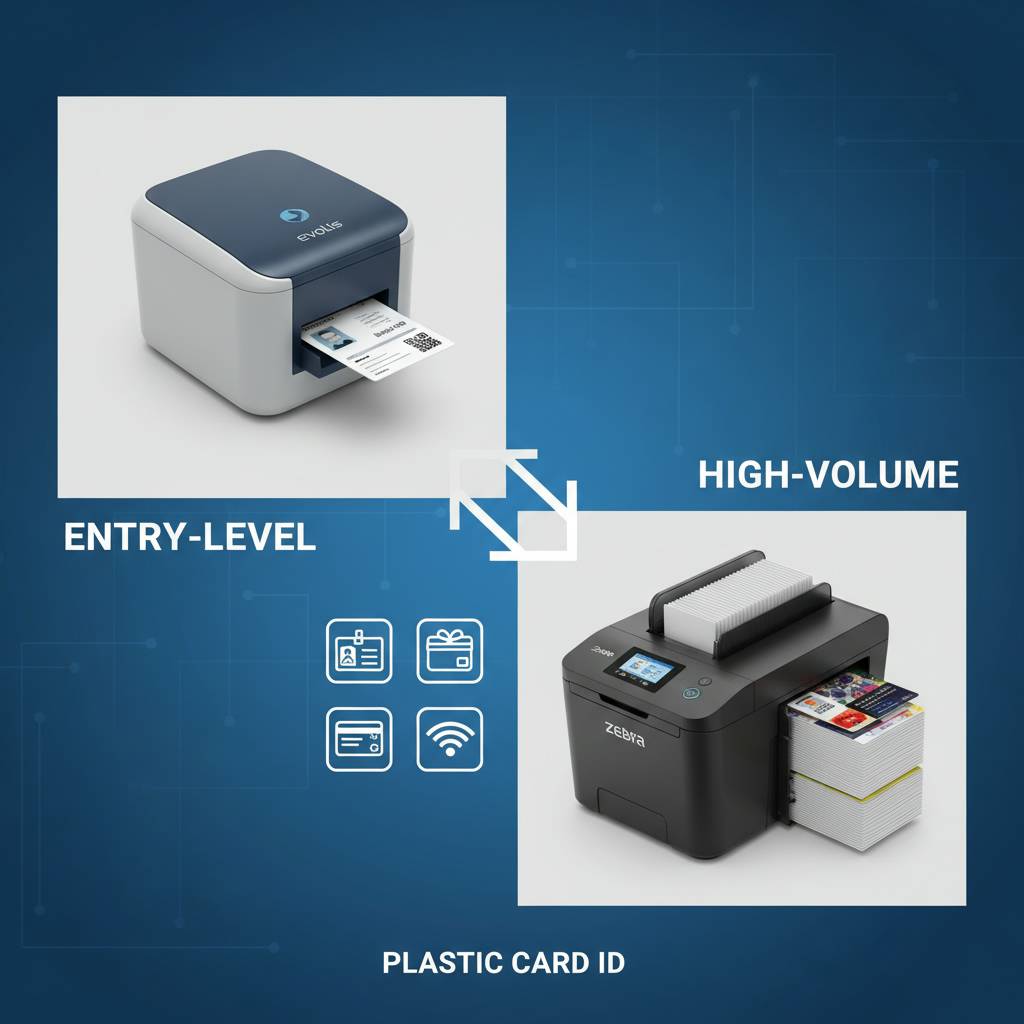
The variety of use cases CPE serves spans industries and organization sizes broadly. Each card type has slightly different requirements - surface durability, encoding type, single versus dual-sided layout, lamination needs - and understanding those differences helps buyers select the right hardware configuration rather than defaulting to a one-size-fits-all approach.
Employee ID and Access Control Cards
Employee ID programs are among the most common card programs in operation, and they frequently combine printed identification with access control encoding. A card that displays an employee's photo, name, and department while also unlocking specific doors or logging time-and-attendance entries needs both a capable printer and the right encoding module. Mid-range and high-volume printers with magnetic stripe or smart chip encoding modules handle this dual requirement cleanly.
Access control cards can use magnetic stripe, contact smart chip, or contactless RFID technology depending on the access control system architecture in place. CPE supplies encoding-capable printers across all three technologies, and the team can help buyers confirm which encoding type is compatible with their existing access infrastructure before the hardware is purchased.
Membership, Loyalty, and Student ID Cards
Membership cards for gyms, clubs, and associations benefit from durable PVC construction and, in many programs, magnetic stripe encoding that integrates with membership management software. Loyalty cards similarly need reliable encoding for points tracking, and the personalization capability of in-house printing means every card can be individualized with member names and account numbers printed directly rather than embossed or stickered afterward.
Student ID cards carry their own set of requirements - school logo branding, student photo, grade level or department, and often a barcode or magnetic stripe for library access, cafeteria accounts, or building entry. The ability to print and encode these cards on demand, without waiting for an outside vendor's turnaround time, is a meaningful operational advantage for schools and universities managing large, frequently updated student populations.
Hotel Key Cards and Event Credentials
Hotel key cards are a magnetic stripe encoding application at their core - the printed face simply needs to look professional and consistent with the property's brand. Mid-range printers with magnetic stripe encoding handle this well for properties managing their own key issuance rather than outsourcing to a vendor. For hotel groups with multiple properties, in-house printing gives each location control over its own card stock without waiting for centralized distribution.
Event credentials - badges, lanyards, access passes - need speed above all else during registration windows. The Matica Event Printer excels here, but even mid-range units like the Primacy2 serve smaller event scenarios effectively. CPE helps event operators choose the right configuration based on expected badge counts, event duration, and whether on-site reprinting capability is needed for lost or damaged credentials.
Why Plastic Card ID Is the Partner Your Card Program Needs
 There are plenty of places to buy a card printer. What separates Plastic Card ID from a generic reseller isn't the product catalog - it's the depth of knowledge behind every recommendation, built across more than 25 years and over 100,000 customers. When you call CPE, you reach people who understand card programs end-to-end, not just the hardware spec sheets.
The full-program support model matters because card printing isn't a one-time purchase. Printers need ribbons and cleaning supplies. Programs evolve and require encoding upgrades. Volumes grow and hardware needs to scale. Having a supplier who stocks the complete ecosystem - hardware, consumables, accessories, and the expertise to configure all of it correctly - is the difference between a card program that runs smoothly for years and one that constantly hits frustrating dead ends.
The Value of Buying Through an Experienced Supplier
Generic online marketplaces sell card printers. What they rarely sell is guidance. Buying a mid-range printer that doesn't support the encoding type your access control system requires is an expensive mistake. Selecting a ribbon type that's incompatible with your card stock is a quality and cost problem that shows up immediately. These are exactly the pitfalls that CPE's experienced team helps buyers avoid before the order is placed.
The consultation process at CPE starts with your actual requirements - volume, card types, encoding needs, budget - and works backward to the right hardware and supply configuration. That's a fundamentally different experience than reading a product description page and hoping the specs align with your program's reality.
Complete Supply Chain: Ribbons, Consumables, and Accessories
Printers without a reliable supply chain are frustrating assets. Running out of ribbon in the middle of an onboarding batch, discovering your cleaning kit is back-ordered from an offshore supplier, or waiting three weeks for a replacement printhead - these scenarios have real operational costs. CPE maintains inventory on all the consumables needed for every supported printer model, keeping programs running without unnecessary interruption.
YMCKO ribbons for full-color jobs, monochrome black ribbons for cost-effective text-and-barcode output, holographic laminate overlays, magnetic stripe card stock, smart chip compatible PVC cards, card carriers and sleeves - everything a card program consumes on a recurring basis is available through a single, experienced supplier. That supply chain reliability is part of what 100,000 customers have come to depend on.
Getting Started or Scaling Up - We're Here for Both
Whether you're launching your organization's very first card program or replacing aging hardware in a high-volume operation that prints thousands of cards per week, the starting point is the same: a conversation with someone who understands what you're trying to accomplish and which hardware will accomplish it best. Contact 800.835.7919 to speak directly with the CPE team and get a recommendation built around your real requirements, not a generic one-size-fits-all suggestion.
The right printer, configured correctly from day one, pays for itself in reliability, efficiency, and professional output that reflects well on the organization issuing the cards. That's the outcome CPE has been helping businesses achieve for over 25 years, and it's exactly what a conversation with the team is designed to deliver.
Ready to find your perfect card printer? Plastic Card ID is standing by. Call 800.835.7919 today and let's build the right card program for your organization.
Previous Page