Direct-to-Card Printing vs Retransfer Printing: Key Differences
Table of Contents []
- Direct-to-Card Printing vs Retransfer Printing: Which Technology Does Your Organization Actually Need?
- Understanding Direct-to-Card Printing: How It Works and Where It Excels
- Retransfer Printing: The Premium Approach to Card Personalization
- Comparing Costs: Hardware, Ribbons, and the Real Per-Card Math
- Key Card Printer Models From Plastic Card ID and Where They Fit
- Frequently Asked Questions About Card Printing Technology
- Why Plastic Card ID Is the Right Partner for Your Card Printing Program
Direct-to-Card Printing vs Retransfer Printing: Which Technology Does Your Organization Actually Need?
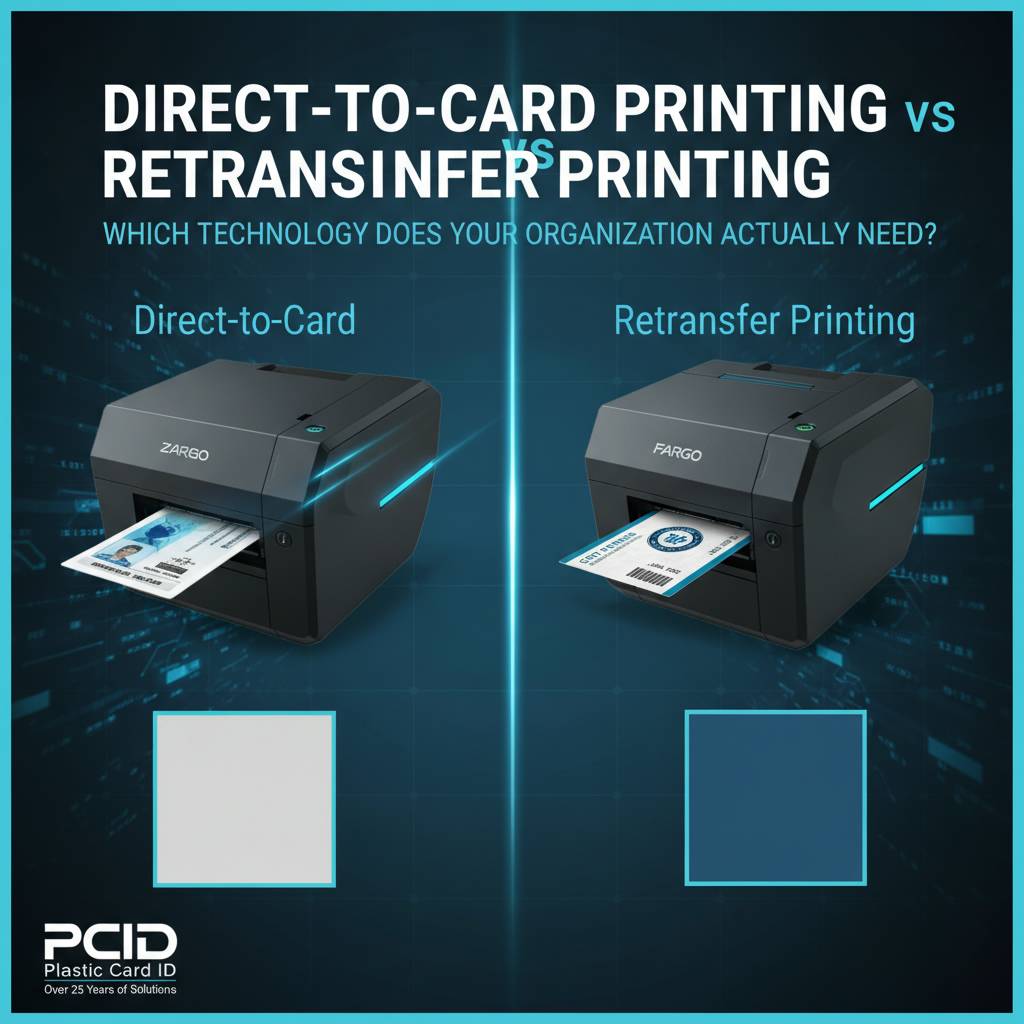 Two technologies dominate the professional card printing world, and choosing between them is rarely as simple as picking the cheaper option. Direct-to-card and retransfer printing each serve distinct use cases - and understanding the difference could mean the difference between a polished, professional credential and a card that falls short of your standards. Whether you are setting up an ID program for the first time or scaling an existing one, Plastic Card ID has spent over 25 years helping businesses across the United States make this exact decision.
This guide breaks down both technologies with real clarity - no fluff, no oversimplification. You will walk away knowing which method fits your production volume, card type, budget, and quality requirements. And if questions remain, the team at Plastic Card ID is ready to help you configure the right system from the ground up.
| Feature | Direct-to-Card (DTC) | Retransfer |
|---|---|---|
| Print Method | Dye sublimation directly onto card surface | Print onto film, then laminate onto card |
| Image Quality | Excellent for standard cards | Superior; true edge-to-edge coverage |
| Edge Coverage | White border typically visible | Full bleed, no border |
| Card Compatibility | Standard PVC cards | PVC, ABS, and irregular surfaces |
| Speed | Faster per card | Slightly slower due to two-stage process |
| Cost | Lower hardware and consumable cost | Higher upfront and per-card cost |
| Durability | Good with overlay panel | Excellent; film provides added protection |
| Best For | Employee IDs, membership, loyalty cards | High-security IDs, government, premium credentials |
Understanding Direct-to-Card Printing: How It Works and Where It Excels
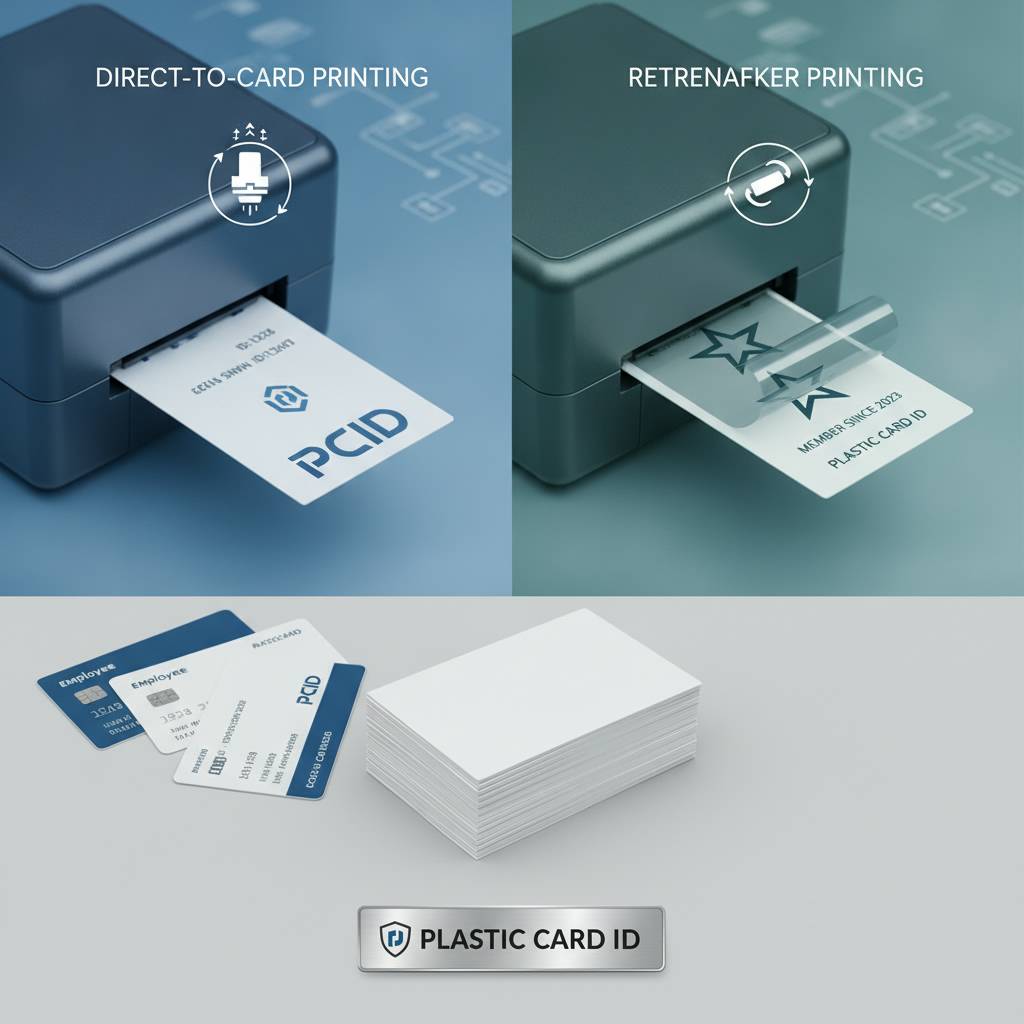 Direct-to-card printing - often abbreviated as DTC - is the method most organizations encounter first, and for good reason. It is fast, cost-effective, and produces professional results across an enormous range of ID card applications. The mechanics are straightforward: a thermal print head applies dye from a ribbon directly onto the surface of a PVC card, panel by panel, until a full-color image is formed.
The ribbon is the heart of this process. A standard YMCKO ribbon deposits yellow, magenta, cyan, and black panels, then applies a clear overlay for protection. The result is a vivid, full-color card that handles daily use well. Plastic Card ID supplies ribbons for every DTC printer in its lineup, from the entry-level Evolis Badgy200 to robust mid-range systems like the Evolis Primacy2.
The Dye Sublimation Process Explained
Dye sublimation is a thermal process where heat converts solid dye directly into a gas, which then diffuses into the surface of the card. This is not ink sitting on top of the card - it becomes part of the card's top layer. That distinction matters enormously for durability, color depth, and resistance to smearing or flaking under normal handling conditions.
Because dye is absorbed into the card material, the transitions between colors are smooth and photographic in quality. Employee photos, logos, and fine text all render with clarity. The overlay panel, applied as the final step, adds a protective coating that extends card life considerably without adding visible thickness or texture.
Ideal Use Cases for Direct-to-Card Printers
The DTC method is the right choice for the vast majority of professional card programs. Employee ID badges, student identification cards, membership credentials, loyalty cards, hotel key cards, and event badges are all well-served by direct-to-card printing. These applications demand professional appearance and reliable encoding support, both of which DTC printers deliver consistently.
Volume is a key consideration. The Evolis Badgy200 suits organizations printing fewer than 1,000 cards annually. Step up to the Evolis Zenius or Primacy2 for monthly volumes in the 1,000-6,000 range. These mid-range workhorses handle dual-sided printing and support optional encoding upgrades for magnetic stripe and smart chip - making them genuinely versatile for complex ID programs.
Limitations Worth Knowing Before You Buy
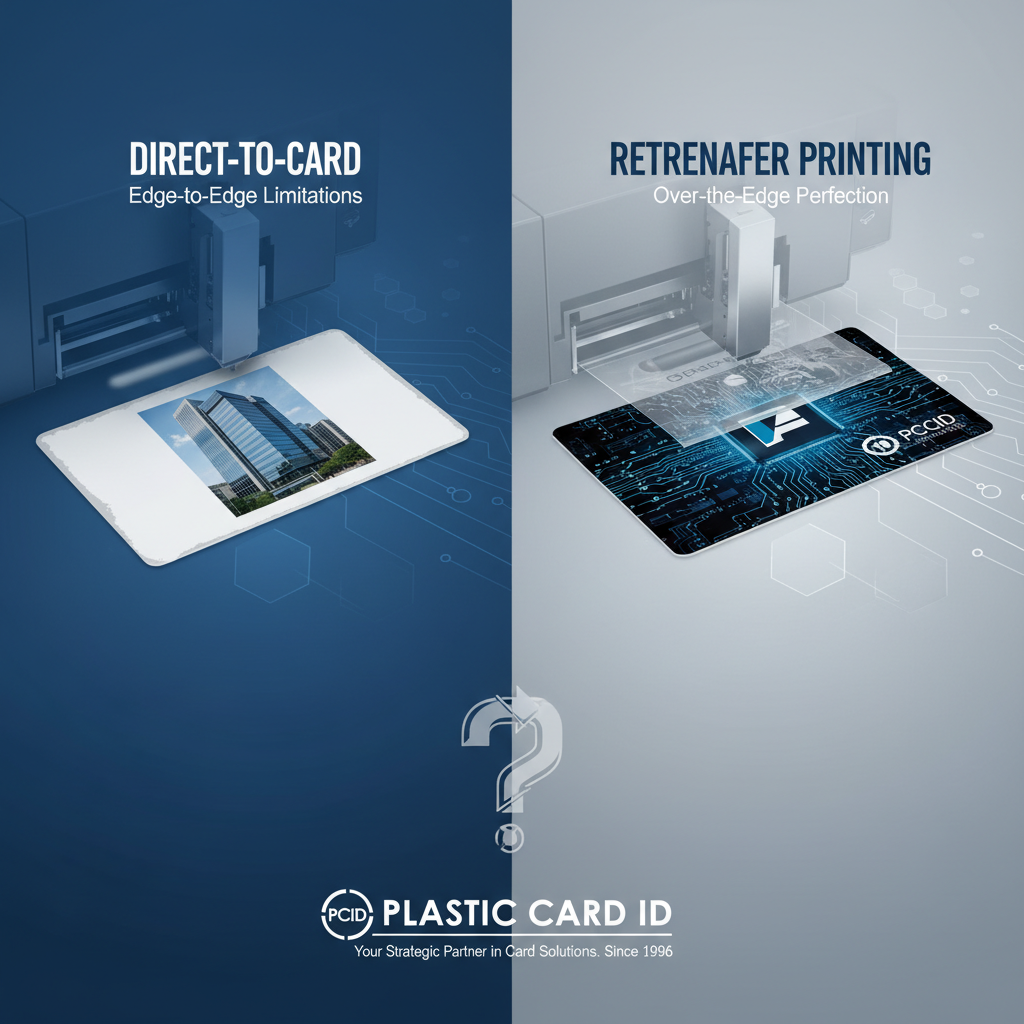
DTC printing does have real limitations. The most notable is the white border - a small unprinted edge that appears around the card perimeter. This occurs because the printhead cannot physically reach the extreme edge of the card. For many applications, this is entirely acceptable. For others, particularly high-prestige credentials or brand-sensitive designs, it is a dealbreaker.
The other limitation involves card surface compatibility. DTC printers require a smooth, standard PVC card surface for proper dye transfer. Cards with embedded chips that create surface irregularities, or cards made from alternative materials, may not accept the dye uniformly, leading to inconsistent results. Retransfer printing addresses both of these specific constraints.
Reach CPE at 800.835.7919 to discuss whether a DTC model handles your card design and volume requirements before committing to a system.
Retransfer Printing: The Premium Approach to Card Personalization
Retransfer printing takes a fundamentally different path to the same destination. Rather than printing directly onto the card, the printer first creates the image on a clear retransfer film. That film is then thermally bonded to the card surface in a second step. The result is true edge-to-edge coverage, exceptional color depth, and a laminated surface that is inherently more durable than a standard DTC card with overlay.

This two-step process is why retransfer printers are typically slower per card than their DTC counterparts. It is also why they cost more, both in hardware and consumables. But for organizations where image quality and card durability are non-negotiable, the investment is entirely justified. Premium credentials convey institutional credibility in a way that budget options simply cannot replicate.
Why Edge-to-Edge Printing Matters
Consider a corporate ID with a full-bleed background image or a government-issued credential with a precise color field that runs to the card edge. A white border on that card does not just look unprofessional - it can undermine the legitimacy of the credential itself. Retransfer printing eliminates this concern entirely by bonding an oversized film image to the card, ensuring complete coverage with no visible perimeter gap.
For security-sensitive applications, edge-to-edge printing also reduces the visual margin where tampering or counterfeiting attempts might begin. When the design reaches every corner of the card, there is simply less visual ambiguity for bad actors to exploit. This is one reason why government agencies, universities, and healthcare institutions increasingly favor retransfer technology for their highest-security credential programs.
Card Surface Flexibility: ABS, PVC, and Beyond
One of the most underappreciated advantages of retransfer printing is its compatibility with a wider range of card materials and surface profiles. Because the image is printed onto film rather than directly onto the card, surface irregularities do not disrupt the print quality. Cards with embedded smart chips, proximity antenna bumps, or alternative material compositions are all handled gracefully by retransfer printers.
ABS cards, which are common in access control and high-security environments, require retransfer printing for best results. Standard DTC printers struggle with the surface chemistry of ABS, often producing muddy colors or inconsistent transfers. Retransfer technology sidesteps this entirely, printing to film first and then laminating cleanly regardless of what lies beneath.
Durability and Tamper Resistance of Retransfer Cards
The retransfer film that covers a finished card is not merely decorative. It is a genuine protective layer that makes the underlying image significantly harder to scratch, abrade, or chemically attack. This matters in environments where cards are handled frequently, exposed to outdoor conditions, swiped through readers hundreds of times, or subjected to cleaning procedures.
Beyond physical durability, the laminated surface creates a tamper-evident barrier. Attempting to alter or delaminate a retransfer card visibly damages the card in ways that are hard to conceal. For ID programs where card integrity is a security requirement rather than merely a preference, this characteristic alone can justify the higher per-card cost of retransfer consumables.
Comparing Costs: Hardware, Ribbons, and the Real Per-Card Math
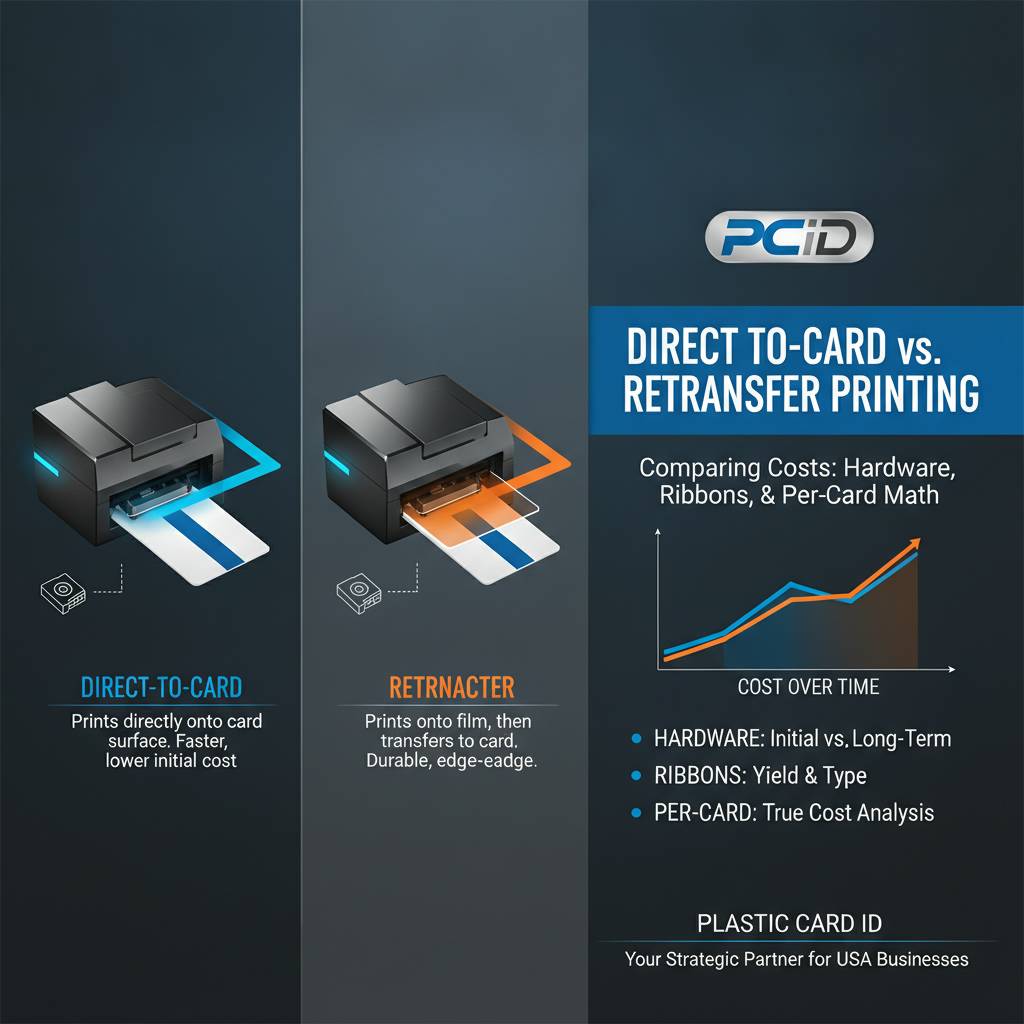 Sticker price comparisons between DTC and retransfer printers rarely tell the full story. The true cost of any card printing program includes hardware, ribbons, cleaning supplies, cards, and labor - spread across your expected print volume. CPE at Plastic Card ID can help you run through this math accurately before you buy, but here is a framework to start with.
Entry-level DTC printers like the Evolis Badgy200 represent the most accessible starting point for low-volume programs. Mid-range DTC systems from Evolis, Fargo, and Zebra occupy a wider price band and offer increasingly robust feature sets. Retransfer printers sit at the premium end of the hardware spectrum, and their retransfer film ribbons cost more per card than standard YMCKO ribbons. However, the durability advantage means cards last longer - which has its own cost implications over time.
Breaking Down Direct-to-Card Consumable Costs
A standard YMCKO ribbon for a mid-range DTC printer typically yields 200-500 prints depending on the model. Monochrome ribbons yield far more prints per roll and are significantly cheaper per card, making them excellent for applications where color is not required, such as simple text-only employee badges or basic access control cards. Cleaning kits and lamination modules add to the ongoing cost but are manageable when purchased through a reliable supplier like Plastic Card ID.
Specialty ribbons - including those with fluorescent security panels, metallic finishes, or integrated holographic overlays - cost more per print but add security and visual distinction that some programs require. The right ribbon choice depends entirely on what your cards need to do and how long they need to last in the field.
Retransfer Consumable Costs and Long-Term Value
Retransfer printing uses a two-part consumable: the YMCK ink ribbon that creates the image and the retransfer film that bonds to the card. This dual-consumable model does raise the per-card cost above DTC equivalents, sometimes meaningfully so. However, organizations printing high-value credentials - government IDs, premium corporate badges, access control cards - often find that the per-card cost difference is trivial relative to the cost of reissuing damaged or counterfeited cards.
Factor in card longevity. A retransfer card used daily in a high-friction environment routinely outlasts a DTC card by a significant margin. If your program involves frequent card replacement due to wear, the economics of retransfer can actually favor lower total cost over a multi-year horizon. It is worth modeling both scenarios with realistic replacement rates before assuming DTC is cheaper overall.
Getting the Best Value From Your Investment
- Match the printer to your actual annual volume - overspending on capacity you will never use inflates cost without benefit.
- Factor in encoding requirements early. Adding magnetic stripe or smart chip encoding later costs more than buying a model with built-in encoding from the start.
- Consider ribbon yield carefully. A slightly more expensive ribbon with higher yield often reduces your actual cost per card.
- Buy cleaning kits and use them consistently. Neglected printer heads fail prematurely, and replacement parts cost far more than routine maintenance.
- Ask about input hoppers if your program involves bulk printing runs. Manual card feeding at volume is a hidden labor cost that high-capacity hoppers eliminate.
Key Card Printer Models From Plastic Card ID and Where They Fit
 Knowing the technology is one thing; knowing which specific printer delivers it at your scale and budget is another. Plastic Card ID carries a curated lineup from Evolis, Fargo, Zebra, and Matica - each brand bringing distinct strengths to different segments of the market. This is not a catalog dump. Every model in the lineup was selected because it solves a real problem for a real type of organization.
The Evolis family alone covers an impressive range, from the compact Badgy200 for occasional use to the premium Agilia for organizations demanding the highest edge-to-edge quality the market offers. Fargo and Zebra bring deep expertise in security-focused ID programs, where encoding reliability, printer lockdown features, and credential durability are paramount. Matica rounds out the lineup with the Event Printer, purpose-built for high-speed on-site badge production.
Evolis Lineup: Entry Through Premium
The Evolis Badgy200 is a straightforward choice for organizations printing under 1,000 cards per year - schools running a small ID program, small businesses issuing staff badges, community organizations managing membership cards. It is compact, affordable, and produces results that comfortably exceed what any outside print service can offer in terms of turnaround speed and personalization.
The Evolis Zenius and Primacy2 step up meaningfully in throughput, build quality, and feature availability. Both support dual-sided printing and are available with magnetic stripe encoding and lamination modules. The Primacy2 in particular has earned a strong reputation in mid-market corporate ID programs for its reliability and consistent output quality at sustained production volumes. The Evolis Agilia handles the premium tier, delivering the edge-to-edge results that retransfer technology makes possible.
Fargo and Zebra: Security-First ID Printing
Fargo printers have long been a standard in government, law enforcement, and corporate security environments. The brand's focus on encoding precision and credential durability makes it a natural fit for access control card programs where a misprinted or misencoded card is not merely inconvenient - it is a security gap. Fargo's range spans direct-to-card models suitable for mid-volume programs through to advanced systems supporting complex encoding schemas.
Zebra brings similar credibility to the enterprise ID market. Known for their hardware reliability and extensive software integration capabilities, Zebra printers are frequently chosen by large organizations running centralized or distributed ID issuance programs. If your program needs to plug into an existing identity management or access control infrastructure, Zebra's compatibility profile is worth examining closely. Contact CPE at 800.835.7919 to explore which Fargo or Zebra model aligns with your security architecture.
Matica Event Printer: On-Site, High-Speed Badging
Event credentialing is a genuinely distinct use case from ongoing employee or membership card programs. Speed is the primary requirement when hundreds or thousands of attendees need printed badges on arrival. The Matica Event Printer is designed for exactly this scenario, delivering high-speed output that keeps registration lines moving without sacrificing print quality.
For conference organizers, trade show managers, and event production companies, the Matica offers a level of on-site control that pre-printed badge sets simply cannot match. Last-minute registrations, substitutions, and VIP upgrades are handled instantly. Combined with the right card design software and a laptop, this printer transforms the credential desk from a bottleneck into a smooth operation.
Frequently Asked Questions About Card Printing Technology
Customers navigating this technology for the first time - and sometimes for the tenth time - tend to arrive with the same core questions. Here are honest answers to the questions Plastic Card ID hears most often, drawn from over 100,000 customer interactions across 25-plus years in the industry.
Can I Switch From DTC to Retransfer Later?
Technically, yes - but practically, it means purchasing a new printer. DTC and retransfer printers are fundamentally different hardware, and there is no upgrade path that converts one to the other. This is why it pays to think carefully about your long-term requirements before selecting a model. If your program is likely to grow into security credentials or premium-grade output within the next few years, starting with retransfer can be the more economical long-term choice.
That said, many organizations run both types of printers simultaneously, using DTC units for high-volume standard badges and retransfer systems for limited-issuance high-security credentials. Plastic Card ID can help you design a mixed program that allocates each technology where it adds the most value.
Does Print Method Affect Encoding Reliability?
The print method itself does not directly affect encoding performance - encoding is a separate process handled by dedicated modules for magnetic stripe or smart chip. However, the mechanical path a card takes through the printer does influence encoding quality, and higher-end printers from all four brands in the Plastic Card ID lineup are engineered with tighter card transport tolerances that contribute to more consistent encoding results.
For programs where encoding accuracy is critical - access control cards, smart campus credentials, loyalty programs with stored value - selecting a printer with a factory-installed encoding module rather than an aftermarket addition is generally the more reliable approach. Built-in modules are calibrated to the specific printer mechanics, which reduces the margin for error.
What Maintenance Does Each Technology Require?
Both DTC and retransfer printers reward consistent, straightforward maintenance with dramatically extended service life. Cleaning kits - typically consisting of cleaning cards and swabs - should be used at regular intervals as specified by the manufacturer, usually every ribbon change or every few hundred prints depending on the model and environment.
Retransfer printers have an additional component to maintain: the heated roller that bonds the film to the card. This component should be inspected periodically for debris or wear. Plastic Card ID supplies cleaning kits and maintenance consumables for every model it carries, making it straightforward to keep any printer in the lineup running at peak performance for years.
Ready to configure the right card printing system for your program? The team at Plastic Card ID is standing by to help you match the right technology to your exact requirements.
Why Plastic Card ID Is the Right Partner for Your Card Printing Program
 There is a meaningful difference between a company that sells card printers and one that actually understands card programs. Plastic Card ID has spent over 25 years building that understanding, one customer and one configuration at a time. With more than 100,000 customers served across the United States, the depth of experience represented in that number shapes every product recommendation, every support interaction, and every order fulfilled.
The lineup has been curated deliberately. Evolis, Fargo, Zebra, and Matica are not arbitrary choices - they are the brands that consistently deliver for the use cases CPE and the rest of the Plastic Card ID team encounter most often. Ribbons, cleaning kits, encoding modules, lamination systems, input hoppers, card carriers, and sleeves are all stocked and available because a card program is not just a printer. It is a system, and every component of that system matters.
Complete Supply Chain for Ongoing Operations
Walk away from this page with a printer order, and you will also want to establish a reliable supply chain for the consumables that keep it running. A printer without ribbons is a paperweight, and an expired cleaning schedule means a costly service call. Plastic Card ID supplies everything your program needs on an ongoing basis - so your operation never stalls waiting for a ribbon reorder from an unreliable source.
Whether you need YMCKO ribbons for full-color output, monochrome ribbons for high-volume text-only printing, specialty security ribbons with holographic or fluorescent panels, or lamination film for retransfer printers, Plastic Card ID has it in stock and ready to ship. Pair that with cleaning kits and card stock, and you have a single supplier relationship that simplifies your procurement considerably.
Support Across Every Stage of Your Program
Buying a printer is a moment. Running a card program is an ongoing operational responsibility. The support Plastic Card ID provides extends well beyond the transaction - from pre-purchase consultation to help selecting the right model, through configuration assistance and troubleshooting as your program evolves. That continuity of support is something catalog resellers and marketplace storefronts cannot replicate.
Organizations printing employee ID cards, student credentials, membership cards, access control cards, loyalty cards, hotel key cards, or event badges all have specific operational contexts. The right advice accounts for those specifics - volume, card design, encoding requirements, durability expectations, and budget. That is the kind of conversation Plastic Card ID has been having with customers for more than a quarter century.
Connect With the Team Today
Whether you are comparing DTC and retransfer options for the first time, upgrading an aging printer, or scaling an existing program to meet growing demand, the right conversation starts with a phone call.
Contact Plastic Card ID at 800.835.7919 today - and get a knowledgeable recommendation from a team that has configured more card programs than most companies will ever see. From entry-level DTC units to high-security retransfer systems, Plastic Card ID has the hardware, the supplies, and the expertise to keep your credential program running at its best.
Previous Page